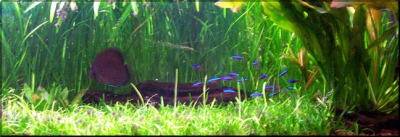
South American Blackwater Stream
Black water pools, creeks and rivers originate in the rain forest areas of the world. The term “Black Water comes from the staining process of the water as it passes through decaying vegetation and roots; discoloring the water to a bronze tea color. These waters are very acidic and soft, the hardness in some areas is negligible.
In South America one of the most famous regions is the Rio Negro which is the second largest tributary of the Amazon, at least 450 miles long by boat but impassable after that due to the number of sandbanks etc. As the tributaries flood many of the ponds and streams are formed; indeed during the flooding season as lot of the fish species will use this as their breeding season, depositing their eggs among the sunken roots and plant life. In black Water habitats the substrate is typically leaf litter over a base of clay or sand. Decaying wood and plant matter is common especially in flooded forest areas. As the floods occur many of the terrestrial plants become submerged but do not suffer any ill side effects as a result.
The pH of the water can be as low as 4.5 and the maximum is usually around 6.5.Temperature of the water is on the high side (27 - 30°C), and as mentioned earlier the hardness of the water will be as low as 0-4 DH. Recreating these conditions in a biotope can be difficult but not impossible.
Setting up the tank
Fine gravel or sand should be used for the substrate with pieces of bog wood either laid on the substrate or mounted horizontally to give the impression of submerged roots. For a realistic effect the lighting should be subdued and a low water flow inside the tank. Peat run inside the filtration system will help to soften the water and reduce the pH. Always test the KH on a regular basis, if it drops too low you run the risk of a pH crash. Keeping it above 3 DH will prevent this from happening.
Plants for the tank
For the background Cabomba planted in groups is ideal, this is normally used in brightly lit tanks but will grow with subdued lighting. Sword plants (Echinodorus) are perfectly happy with low lighting and are found in Black Water areas naturally. Use the larger species at the rear of the tank but plant some of the dwarf species in the fore ground to give a good effect. Vallisneria looks great for the mid to back of the tank set in groups. For a floating species, use the tropical hornwort. This plant can even be used as a bunch plant at the rear of the tank alongside the cabomba.
Fish for the tank
Discus and Angelfish are the two top candidates for this biotope; the golden rule is not to place both species in the tank together. Decide which of the two you wish to add as Angelfish can easily pass diseases onto the discus even though they are not affected themselves.
Corydoras make great substrate cleaners; if adding them it would be better to use a sand substrate as they can damage their barbells on gravel.
Most of the tetra species are ideal; in my own biotope I use a shoal of cardinal tetras with discus, the effect really works.
Loricarids (armoured catfish) will also do a cleaning job on the biotope; Ancistrus are well renowned as aquarium glass cleaners.
Dwarf cichlids, of which there are many to choose from, make for interesting tank viewing, especially if you are lucky enough to get a pair.