How to Care for Freshwater, Brackish & Saltwater Puffer Fish with Details of Species & Forum
Marine Puffer Fish


Quick links - Answers
- Anatomy
- Defence
- Toxins
- Setting up a tank for Puffers
- Equipment of a tank
- Dietary needs
- Cleaning a tank
- How to add new fish
- Possible tankmates
- Diseases of Puffers
- Breeding
- Questions and answers
Advice by Jan, keeping fish since 1995

Brief Description
This page is an ultimate guide on raising freshwater/brackish Puffer fish with FAQ, pictures and forum with answers. There are more species that are called "Puffer fish", thus we're not describing each of them on this single page and we also have a marine section dedicated to Puffers, make sure you visit the following pages too: Dogface Puffer, White-Spotted Puffer, Guineafowl Puffer, Starry Pufferfish, Spotted Toby, Saddle Valentini Puffer, Prickly Puffer, Green Rough-Backed Puffer, Silverstripe Blaasop, Pygmy Puffer. We'd love to hear your experiences with these species, so leave your comment at the bottom of this page!
Freshwater and Brackish Puffer Fish - Introduction
Puffer is a very unique fish, actually many people love them because they look very cute, every specimen has its own personality. The name “Pufferfish” is derived from the ability to puff their bodies which occurs if they feel scared, threatened or in case other fish attempts to eat them. Even though these fish look clumsy, they are very active and watching them swim is a fascinating experience. Most of them (except for the Tetraodon schoutedeni) are extremely aggressive, so they have to be kept alone in the tank and they are not ideal for beginners.
Fish anatomy - Fins
Fins of these species are unique, they are used in a different manner than how other fish use their fins. Normally, fish use their tail fin for moving straight, but puffers use mainly their pectoral fins along with dorsal and anal fins for moving. The tail fin is used for the purpose of changing direction only. Such fins allow easy movement even backwards.

Fish anatomy - Body
The bodies of Pufferfish look mostly like a ball for American football, however they are perfectly adapted to their environment and living habits. The head is large and they have big eyes which are wide apart. Such eyes allow Puffers to hunt effectively. Also, most of these fish have toxic skin which is why they do not have any natural predators.
Fish anatomy - Teeth
Puffers have four teeth which is why they are called tetraodon (tetra = four). There are two teeth in the upper mandible and two in the lower mandible, big Puffers can even nip a human if such a fish is handled incorrectly. Teeth can become overgrown and inappropriately kept Puffers may starve because they’re unable to eat with overgrown teeth. Fish can’t visit a dentist, therefore it’s crucial to feed them food that is hard enough to naturally grind their teeth – such food includes aquatic snails, cockles and crustaceans with shells. Trimming teeth is possible to do, however you need a big puffer and experiences in order to perform this task, some vets may be helpful if your fish need this kind of maintenance.
Defence
As mentioned above, Puffer fish are able to puff themselves to a ball shape in order to avoid being eaten which is a unique way of defence. They inflate water or air and make a kind of a balloon out of themselves. It is all possible due to sacs in the oesophagus which makes fish capable to suck in water or air and change the shape of the fish. Some types of puffers have also spines, which appear when they swell up. As a result of this mechanism such Puffers are too big to be swallowed and chewing them might be painful too. After all water can be expelled from the body which these fish use for an unexpected and quick move backwards. Lastly, many Puffers have toxic skin, thus predators have learnt to leave them alone.
Attention: Do not try to swell up a puffer by lifting it up from the water and tickling its belly. The fish will be stressed and you can cause a lot damage to the fish. The fish may swim with its belly up, however it’s also possible that it’ll submerge itself and hide.
Toxins
Poisonous animals often warn other organisms about being poisonous through colouration which is the case of Puffer fish too; Tetrodoxin which is secreted in case of danger, along with other toxins, is produced by Tetraodons and could be lethal for other fish kept in tank with them. Toxins are produced when these fish feel endangered or frightened.
Aquarium set-up for a puffer fish
Generally speaking, Pufferfish as a species can be divided to three categories: Freshwater, Brackish and Marine. However we have a section dedicated to marine fish here: aqua-fish.net/salwater, so this particular article is devoted to freshwater and brackish Puffers. As with any other fish, research what conditions your fish require before you bring it home. A lot of aquarists keep visiting Aqua-Fish.Net just to realise that their Puffer is not a freshwater species, but a brackish one instead.
Water parameters - General
Since lots of of aqua-fish.net's visitors are newbies, let's explain the basics below:
- It is crucial to understand that various puffers may differ in their requirements as there are Puffers that originate from Asia, Africa or saltwater regions. Therefore parameters of a freshwater aquarium for Tetraodons are different from parameters of a brackish tank. The main parameters you should focus on are pH, general water hardness, carbonate hardness and temperature.
- Hardness tells the amount of certain dissolved salts in the water. The general hardness (GH) measures the levels of calcium or magnesium in the water. Soft waters have value below 8°N dGH (142.86 ppm, 2.86 mEq) and hard water is above 18°N dGH (321.43 ppm, 6.43 mEq).
- pH is an indicator which tells if the water is acidic, neutral or alkaline. Actually it's the concentration of hydrogen ions in water. The more hydrogen ions are to be found in the water, the more acidic the water is. The acidic water is characterised by pH ranging from 0 to 7 (7 not included), 7 is neutral water, and pH above 7 is alkaline.
Freshwater species – Tank setup
Freshwater puffers are more sensitive to extreme values of water chemistry in comparison to brackish species as conditions are not likely to change unexpectedly or too fast in freshwater lakes or creeks. There's something that Puffers have in common even though every species requires slightly or fairly different conditions, you're welcome to use our search page – it will help you to understand specific requirements of fish that are listed in our database. The “common” things for a properly setup Puffer tank are as follows:
- Fine gravel or top-notch sand should be used as substrate. Never introduce a Puffer to a tank with no substrate as many of them love to hide or dig in sand.
- Hiding places are another “must have” as Puffers are known to spend a lot of time being hidden, additionally many of these fish are nocturnal. Tufa rock, pebbles, sandstones are ideal for this purpose. Rocks or other objects that are put to a fish tank must be aquarium-safe which means they must not affect water quality, they should not be of sharp shape as such shapes may injure a fish.
- Driftwood can be added to a Puffer tank. Bear in mind that too much of driftwood could reduce pH, so performing regular water changes and testing water quality on a regular basis is a must do in such a case. Driftwood should be boiled in order to remove parasites or diseases from it especially if it hasn't been obtained from a trustworthy source.
- Plants should be grown in a Puffer fish tank, they decompose fish' waste. Moreover plants produce oxygen; Good plants include Echinodorus, Cryptocoryne, Anubias, Ceratophyllum, Microsorium, Pistia, Riccia.
Equipment:
- Light, so your plants can grow properly. Newbies or aquarists who aren't skilled enough often leave lights turned on 24/7, however plants and fish must be given normal amounts of light, therefore light shouldn't be turned on for longer than 12 hours a day. Not only longer days cause stress, it also causes algal bloom. Make sure there are floating plants in the tank in case the light is too bright as in combination with bright substrate this can stress out the fish. Additionally consider requirements of plants when choosing light bulbs for your tank; Plants such as Anubias aren't too demanding in terms of light, thus don't expose your fish to undesirable amount of light for no reason.
- Filtration, any reliable filter is OK, it doesn't matter whether it's an internal one or an external canister filtration system. Undergravel filtration isn't perfect for a tank with sandy bottom as small particles may clog up the filter.
- Water heater and thermometer, because monitoring temperature and increasing it if it's too low is crucial and is basically the first thing to start with even before adding fish or plants into an aquarium. Once again, it is impossible to tell ideal temperature for a Puffer tank here as there are many species as mentioned above – make sure you check our list of these fish at the bottom of the article to find more about ideal temperature for each species.
Brackish puffer – Tank setup
As we know, brackish water is something between freshwater and marine environment. The amount of salt in water is measured by the parameter called specific gravity (SG) with a device called hydrometer which measures the amount of salt with density. SG of the fresh water is 1,000, and saltwater has a SG of about 1,025. Brackish water should have a SG ranging between 1,005 and 1,015, although it must be a stable value and must not vary during the day randomly. The easiest way how to prepare brackish water is to buy a mixture for salt water, and then prepare the marine water out of it. Once you're finished, mix one part of the marine water and one part of fresh water and you should normally get brackish water, because if you mix one part of 1,025 and 1,000, the final SG should be at 1,0125 after all. Brackish puffers tolerate wide range of salinity and temperature, because it varies in their natural environment too.
In general we know two types of brackish set-ups: the mangrove swamp and the typical aquarium appearance, naturally it's up to you to choose one of these. The Mangrove swamp setup/biotope looks more natural as it's built on a sandy bottom (which can be replaced with fine gravel in case you can't find suitable sand), tufa rocks and wood that is found anywhere in mangrove swamps. Caves can be made of rockworks, however buying pre-made caves is a widely selected option too. Plants that tolerate salty environments are as follows: Elodea canadensis, Ceratophyllum, Sagittaria, Echinodorus, Valisneria spiralis, Hygrophila polysperma, Java Moss and so on.
Just like when setting up a freshwater tank, basic equipment includes filter, heater, lighting, and thermometer. None of used equipment should rust in salt water, thus check whether items that you're about to purchase can stand brackish environment. Hydrometer is another “must have”, choose one that can measure specific gravity of 1,000 and above.
Of course hiding places, rocks, bogwood, eventually flower pots, plants and free swimming places are common for all types of tanks.
What should a puffer fish be fed?
There are Puffers which are carnivorous – they should eat meaty foods only, and the second type is omnivorous – diet of these should be based on both – meat and plants basis.
Diet of carnivorous Puffer fish may include following:
- Aquatic snails – such as ramshorn snails
- Chopped and whole mussels
- Earthworms – be sure that they are clean even from inside
- Flies
- Live or frozen food – blood worms, mosquito larvae, daphnia, freshwater shrimps, Glassworms, Artemia (brine shrimps), Cyclops, Tubifex
- Shellfish – such as cockles, but you need them with the shell
- Whole prawns
Omnivorous puffer fish should be given the above-mentioned foods along with these:
- Aquarium plants - yes, some puffers will eat your plants in the tank
- Courgette
- Lettuce
- Peas
Puffers are known to occasionally accept commercial food too, however this is not a rule and pellets, tablets or flakes must not be offered to a newly introduced fish as it isn't natural and they'll ignore such food. Secondly, mentioned types of food must not be primary diet of your fish (Puffers)! Trace elements and vitamins that can be found in these foods are present in foods mentioned within lists above, but it's a known fact that some Puffers may accept dried brine shrimp or even flakes once they're acclimatised and happy in an aquarium.
Small fish shouldn't be given food that they are unable to eat; Don't be naive, Puffers have big mouths, but food that is too large for their digestive system can't pass through it, therefore many owners keep reporting that their fish spit out the food wondering what is causing this behaviour. So a small Puffer can eat small prawn. Puffers are known to be picky eaters and they often have favourite foods. Naturally diet of your fish must be varied, monotonous diet isn't attractive and it might lack in vitamins/nutriments, thus your fish may be more prone to some diseases as time goes by. Lastly, Puffers must be offered foods that they crunch, otherwise their teeth will grow unwillingly.
These fish should be ideally fed twice a day small amounts of food that is eaten in 30-60 seconds. If a fish ate too much, it's perfectly OK to see it spitting out the food – Give it less food next time. Uneaten food negatively affects water quality, so it's just another reason to avoid overfeeding.
How to clean a Puffer tank
Just like any other aquarium with fish and plants, a Puffer tank too requires regular water changes and water testing which are crucial for having happy and healthy fish. Newbies often change 100% of water once a month in a good belief that such a change is perfect and removes all odour along with unwanted substances including ammonia (frankly speaking, newbies often don't know anything ammonia, nor pH or beneficial bacteria).
Most Puffer tanks need from two to four partial water changes a month, these range from 10% to 25% per week. Large tanks usually require less maintenance as chemistry including pH, specific gravity, process of decomposing excrements, level of harmful toxins is more stable when compared to small tanks. Use a siphon for the task, you don't need to siphon the substrate even though most aquarists would do so. Removing water from top levels of your tank is just fine, however make sure that newly added water is chlorine-free.
Once again I'd like to emphasize the importance of regular testing – rather spend money on prevention than on curing diseases which is more expensive after all. Let's name the basics:
- New water must be chlorine-free! Tap water is OK as long as it's aged – leaving it in a bucket for 24 or more hours is usually ideal period to get rid of chlorine. Chlorine makes breathing difficult for your fish, moreover it reacts with ammonia and produces chloramine which is deadly even in low concentration.
- pH of newly added water should be similar to current pH in your fish tank!
- General water hardness (dGH) must be similar to current dGH in your aquarium!
- Temperature of newly added water must be as close as possible to current temperature in your fish tank!
- Measure specific gravity of newly added water in case you're running a brackish tank! Specific gravity must be same in the bucket and the tank. There are commercial products that make preparation of brackish water easy, simply ask at your local pet store.
- Never rinse filtration media in tap water as this would kill all or mostly all beneficial bacteria, thus the cycling process would be restarted even some bacteria still live in the substrate. It's ideal to perform water changes and filtration media cleaning at the same time because you can use aged water from your tank to rinse the filtration media.
How to add a new fish into the tank
The first paragraph does apply to every specie, however the process is not known to everyone, so let's explain how to introduce a newly bought fish into a fish tank:
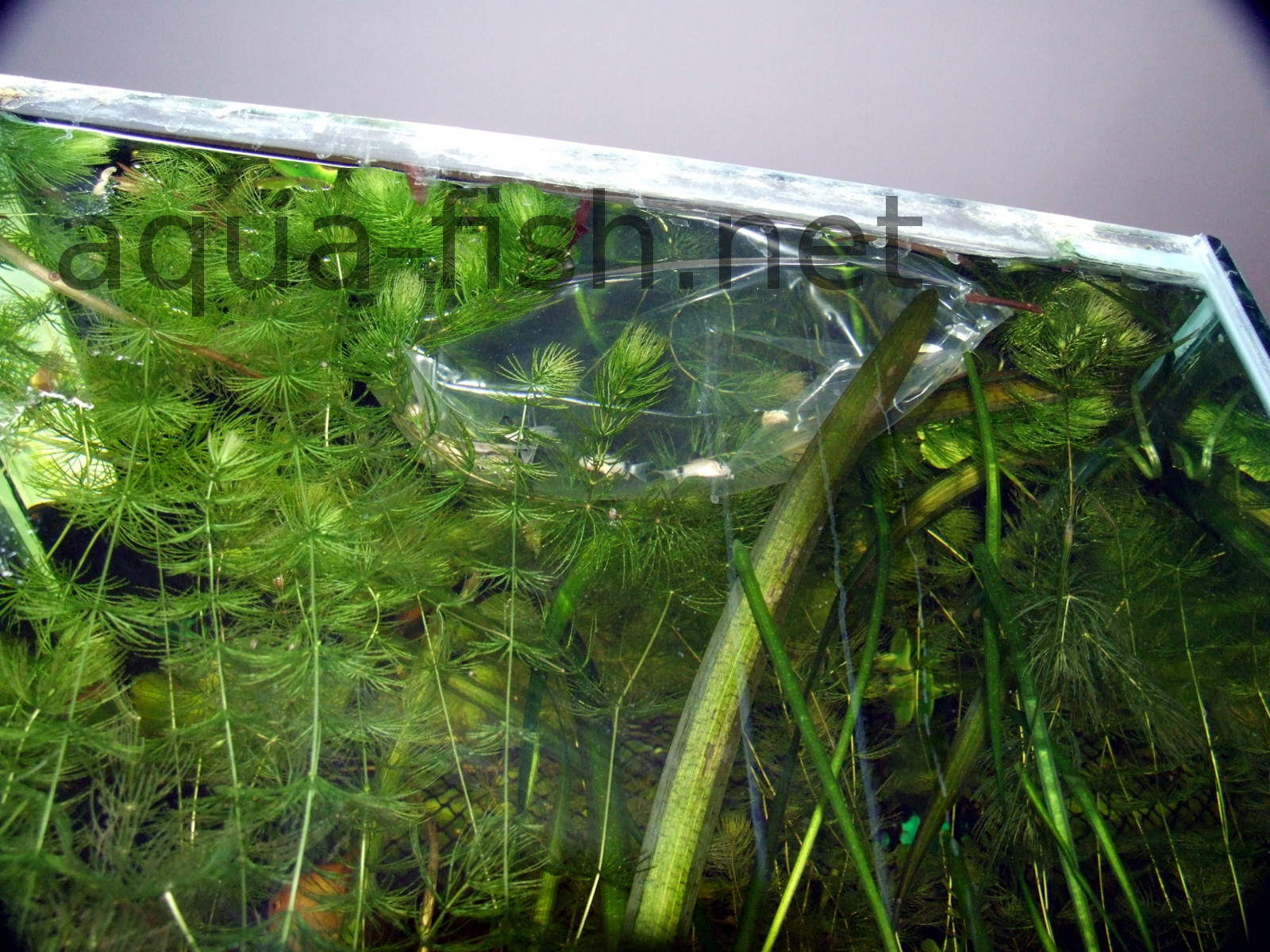
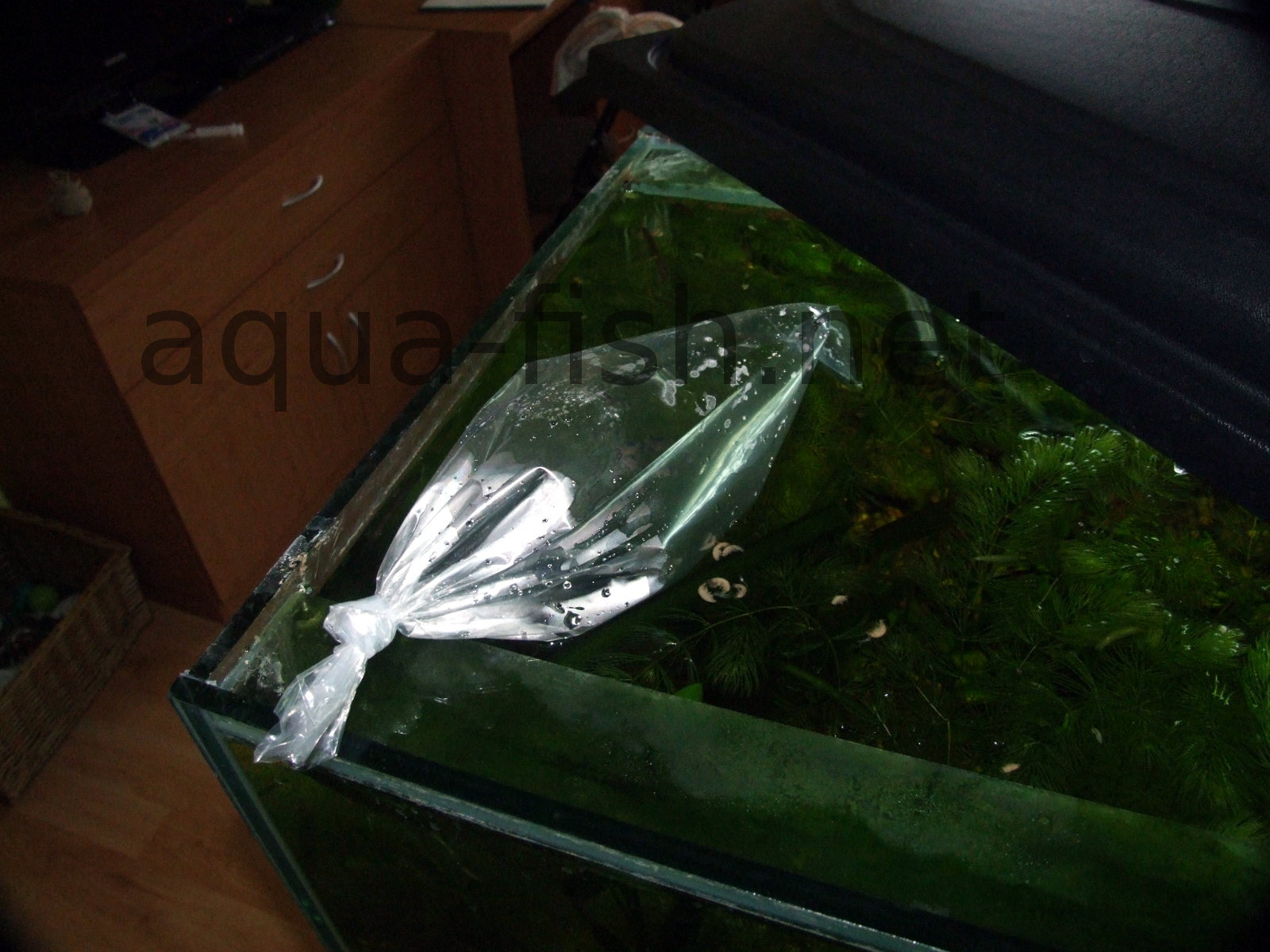
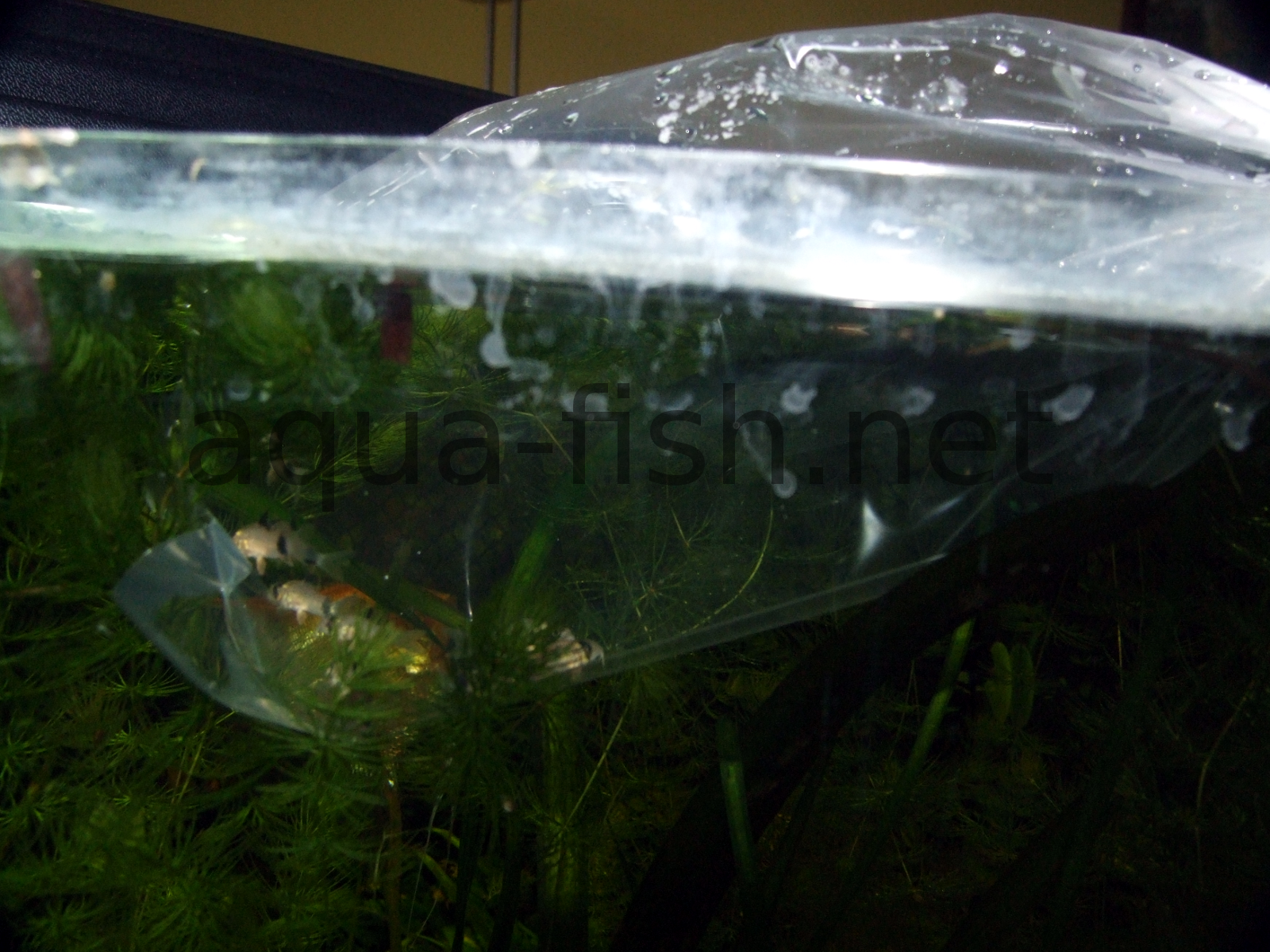
Most fish come in a plastic bag, it's important to turn off the lights before putting that bag into water. Do not open the bag yet, let it float at the top in order to adjust temperatures instead. Let the fish be that way for approximately 10-15 minutes, then it's time to open the bag and let your fish explore it's new home. If temperatures weren't adjusted, the fish could undergo a shock, it could even die. Handle your Puffers gently as they can inflate themselves with air, and there are many cases when they die due to inability to get rid of this air!
(the below shown bags don't contain any Puffer, however they're good for illustration purposes)
As most Puffers are aggressive, it is wise to keep them in a dedicated tank. Otherwise their tank mates should be given enough hiding places, moreover the tank should be reasonably sized. A 50 litre tank (13 US gallons, 11 Imperial gallons) isn't suitable for a Mekong puffer or Green pufferfish, nor it's suitable for such species along with some tankmates. Bear in mind that most Puffers are sold as small specimens that reach maximally 3 cm (1.18 inch) at the time of purchase, but some can grow as large as 20 cm (7.87 inch) or even more! Puffers should be ideally kept alone or in large tanks with fish that know how to strike back.
Tankmates for a Puffer
Since most Puffers are terribly territorial, they're best kept alone. Many aquarists buy Puffers not knowing anything about their true temperament, and end up with single fish in the tank – the only survivor is usually that cute new fish, Puffer. More importantly, a brackish setup isn't suitable for most common aquarium fish.
A few examples of compatibility:
- Amazon pufferfish can live with other species peacefully. Fish that can be combined with this puffer are Angelfish, Blue rams, Pleco's.
- Green pufferfish are known to be tolerant towards other species too, although not every specimen is as peaceful. Moreover these must be kept in a brackish tank as they get older, otherwise lifespan of these Puffers is going to be shortened to only 5% - 10%.
- Mekong puffer is best kept alone. They don't require salty environment.
You're welcome to ask at the bottom of this page in case you're seriously interested in questions regarding compatibility.
Diseases of Puffer fish
The most common diseases that Puffers suffer from are as follows:
-
Whitespot
This highly infectious disease is also called Ich (Ichthyophthirius). Spores may be present in a fish tank, however if your Puffers are in good condition, these spores will have no negative effect on health at all. The disease develops in stressed fish which is a case of poor water quality, constant harassment, inadequate feeding, lack of nutriments and other unnatural states when immune system of fish is put into the test. The most endangered fish are those newly bought, because the transport is one of the most stressing things in the life of a fish. As you can see, this is just another reason to quarantine newly brought fish. Curing the white spot disease isn't that hard, you may ask for proper medications at your local pet store. Moreover we offer two articles on curing this disease: Life cycle of white spot, and White spot cure written by Patrik.
-
Fungus
This disease usually develops in open wounds which may be a result of fight, however sharply edged decorations increase the risk of wounds too. Fish may even get burnt if they stay close to heater for a long time. Curing fungus isn't difficult, there are antifungal medicaments available at pet stores, additionally it's always worth checking whether water quality is outstanding and perform immediate water change or adjustment if it's necessary. Increasing temperature by a few degrees helps too just like in the case of previously mentioned White spot disease.
-
Flukes
Since many Puffers are still wild caught, most parasites that live on skin or gills are transferred to these species in the wild. Gill flukes are impossible to be spotted unless you use a microscope of magnifying glass. However if gill flukes reproduced to a state when there are too many of them, the fish struggles to breathe and it prefers to swim near aerator. Skin flukes will parasite on skin; Cure for skin or gill flukes isn't difficult, however it's important to catch up these diseases at early stages otherwise they might be fatal. Ask at your local pet store for recommended medicaments.
-
Fin rot
This disease uses to develop when fish nip each other's fins, eventually when a fish is handled incorrectly and is for example harmed during the process or netting. Water quality goes hand in hand with this disease, therefore if a fish is kept in outstanding water is exposed to this disease much less than a fish kept in poorly maintained aquarium. This disease can be cured, as usual ask at your local pet store since there are more manufacturers that don't always sell on all markets. Additionally we have an article devoted to this disease here: Fin rot treatment, symptoms, prevention.
Do not forget that puffers have poisonous skin and if you have to touch them, for any reason, always wear gloves on you hands.
How to breed a puffer fish
Breeding Puffers isn't a task for newbies, actually only a few species have been successfully bred in fish tanks. Since many visitors of aqua-fish.net come to this page and ask about their “pregnant” Puffers, I'd like to emphasize that these fish are not livebearers, instead they are spawners. So technically any Puffer cannot get pregnant, because females will only produce eggs that must be fertilised by male outside of her body. Additionally breeding requirements of these species are mostly unknown except for common facts such as plenty of space for large specimens. Moreover most Puffers won't get along, the only exception applies to the breeding period, so raising a pair in one tank is impossible in most cases. Even though some species can be kept in a community tank, sexing is impossible, therefore aquarists never know whether they have a pair, males, or females.
Another challenge is raising the fry; They must be fed very small pieces of meaty food and honestly this is hard to achieve in an ordinary fish tank. The fry can be fed Infusoria or Cyclops, once they're a little bigger it's OK to feed them newly hatched brine shrimp. As newborns grow larger and larger, they can be fed all foods that are given to the adult specimens.
Puffer fish are divided into three groups when it comes to spawning
-
Substrate spawners
They usually dig a small hole into the substrate and lay their eggs into it. Then the parents guard the eggs and later one of both of them look after the fry. Species that belong to this category include Green pufferfish (Tetraodon Fluviatilis) and Twin spot puffer (Tetraodon leiurus brevirostris). Green puffer was successfully bred in brackish aquariums only, even though they live in fresh and saltwater environments.
Both of the mentioned species can lay up to 500 eggs at once, however it's important to remove the female from tank as only the male will guard the eggs. If the tank is big enough, and if the male doesn't become too aggressive towards his partner, it's OK to keep both parents in the same aquarium. The eggs will hatch in 5 days and it's ideal to separate them from parents once they become free swimming as parents will see consider them food later. Newly hatched brine shrimp and Cyclops should be given to newborns, however the survival rate is too low in general. Additionally small Puffers will become aggressive towards each other, so stronger specimens will go after weaker ones. Cannibalism can be reduced by using tank dividers.
-
Rock spawners
As the title says, they lay their eggs on rocks. These Puffers will guard the eggs and fry as there's no shelter on rocks. Species of this group include Sea frog (Tetraodon cutcutia) and Green puffer (Tetraodon nigroviridis).
Rock spawners will firstly clean a rock which is later used for the purpose of laying eggs. The male will guard the eggs for 8-10 days as this time is required for eggs to hatch. Speed of hatching depends on temperature; The higher the temperature, the sooner they hatch. Bear in mind that the male should be removed from the tank once eggs hatch because he might consider them food. The fry should be fed on Cyclops and newly hatched brine shrimps (Artemia salina). As they grow, give them bigger and bigger food.
The difference between Green puffer and Sea frog is in space that should be given to a pair; Sea frogs will require more space, at least 400 litres (105 US gallons, 88 Imperial gallons) as this species is more territorial. It's easy to tell whether they're ready to spawn once they start “dancing” and once the male's tail becomes red on the edge.
-
Plant spawners
As the name of this group implies, such Puffers lay eggs on leaves, in places among leaves and roots of plants. They too guard eggs and fry. This group includes species such as Figure Eight Puffer (Tetraodon biocellatus), Spotted Congo Puffer (Tetraodon schoutedeni) and Red Eye Puffer (Carinotetraodon Lorteti).
The Figure Eight Puffer and the Spotted Congo Puffer lay their eggs onto leaves - the male will chase the female away after they breed. 6 or 7 days later the eggs hatch which is ideal time to separate male from newborns. The fry should be fed on small foods; Best choice is live food, however make sure the source is trustworthy as live foods can pass diseases and parasites on to fish. It's normal for a Spotted Congo puffer male to catch a female when breeding, they almost look like he's eating her, however this is actually the process when eggs are being released and fertilised by male.
The Red Eye Puffer lays about 300 eggs onto Java moos. Just like Spotted Congo puffers, Red Eye Puffers will too display this behaviour when male catches a female in his mouth. Once the eggs are laid, both parents should be removed from breeding tank as there's a high chance the eggs will be eaten. The eggs will hatch in 2 days and they too should be fed Cyclops or Artemia salina, otherwise they're going to starve. Pet stores often sell microworms that are perfectly OK for newborns.
As usual, water quality in a breeding tank must be high, and the tank must be maintained on a regular basis otherwise the survival rate of newborns decreases. Filter, heater, lighting, substrate and plants are a “must have” too, however it's better to use sponge filter since these won't suck newborns inside filtration chambers. Regular water changes are necessary too, don't forget to test water quality.
Pictures of different species


Also check the links shown below; They point to Puffers in our database and each profile contains it's own picture (or pictures).
Links to profiles which contain more specific information
Since there are more than one or two puffer fish species, they're described on different pages:
- Green pufferfish - Tetraodon nigroviridis
- Malabar pufferfish - Carinotetraodon travancoricus
- Giant puffer fish - Tetraodon mbu
- Amazon pufferfish - Colomesus asellus
- Green pufferfish - Tetraodon fluviatilis
- Bailey's puffer - Tetraodon baileyi
- Red-spot puffer - Tetraodon abei
- Mekong puffer - Tetraodon suvattii
- Coral butterfly puffer - Tetraodon lineatus
- Striped red-eye puffer - Carinotetraodon salivator
- Figure eight puffer - Tetraodon biocellatus
- Congo puffer - Tetraodon miurus
- Red eye puffer - Carinotetraodon lorteti
- Fang's puffer - Tetraodon cochinchinensis
- Bronze puffer - Xenopterus naritus
Video
Video with the Green Pufferfish (about 44 MB, MPEG-1 format). Another video: here (about 28 MB).
Puffer fish on the internet
Even though one can find many pages devoted to Puffer fish here on Aqua-Fish.Net, you're also welcome to visit the following webpages, they're all worth it. Figure 8 Puffer Fish - Tetraodon biocellatus @ FishLore.Com, Puffers ~ Pufferfish @ Animal-World.Com, Pufferfish @ AquaticCommunity.Com, Colomesus asellus - Amazon Puffer, Tetraodon biocellatus - Figure Eight Puffer, Tetraodon mbu - Giant Puffer, Tetraodon miurus - Congo Puffer, Tetraodon baileyi - Hairy Puffer all @ SeriouslyFish.Com. If any of the links doesn't work, let us know, please.
Additional questions and answers
We've updated this page once again on March 17th 2011; New answers and questions have been added here, originally these answers were published at aqua-fish.net/answers. If you cannot find answer on your question within this page, feel free to use a form at the bottom of this page and we'll do our best to answer your questions about Puffers! (The questions below may be related to a specific species of Puffer fish)
-
Why has my green puffer’s belly turned grey?
Answer: This is often caused by incorrect water conditions, puffers (there are some exceptions) are not freshwater fish, if kept in this water they will only live for a year instead of 20 years. They need a high calcium level in the water which should be brackish to saltwater. If the color of the bellies darkens it is often a sign of stress.
-
Why does my puffer fish sit at the bottom of the tank?
Answer: Puffer fish are known as active fish but every now and again they can be caught napping, sometimes at the bottom of the tank. While they are doing this they may also change their coloration.
-
What do Puffers like to eat?
Answer: Ramshorn snails and Apple snails. Big Puffers may eat smaller fish.
-
Why do puffer fish turn upside down?
Answer: Sometimes the puffer fish will inhale air to expand but then find that it can’t release it. This has the diverse effect of affecting it’s buoyancy but can be solved quite simply. Holding the fish under the water and gently shaking it will usually be enough to release the air.
-
Why does my green puffer turn dark when the lights come on?
Answer: Green puffers have the ability to change color and this could be a reaction to the initial light burst.
-
Which fish are compatible with puffer fish?Answer: Puffer fish prefer brackish conditions; choose fish that also prefer these conditions like scats and freshwater gobies. If they are to be kept in freshwater tanks then they will be compatible with fast swimming fish like barbs and danios.
-
Where can I buy saltwater puffer fish online?
Answer: On 10/05/08 I was also able to find saltwater puffer fish at www.saltwaterfishshop.com ranging in price from $14 to $360 USD depending on what type you wanted to purchase.
-
Where can I buy freshwater puffer fish online?
Answer: On 10/05/08 I was able to find freshwater puffer fish at www.aquariumfish.net you just need to contact them for availability and pricing information.
-
Where do you find fresh water puffer fish in the wild?
Answer: The freshwater puffer can be found in Brazil, Peru, Columbia, Amazon river basin, Africa and Asia depending on what freshwater species you are looking for.
-
Where do you find saltwater puffer fish in the wild?
Answer: The saltwater puffer can be found in the tropical oceans, near the shores and coral reef.
-
Which tank do I need for freshwater puffer fish?
Answer: Puffer fish should be homed in larger tanks rather than a small one, plenty oh hiding places should be included as they like to rest occasionally.
Saltwater Pufferfish

 A guide on setting up a brackish tank; With forums
 An article on keeping Giant Pufferfish with forum