The Neon tetra - Forum & Guide on care, feeding, breeding

Quick links – Answers
- Tank size
- Are these fish easy to keep?
- Biotope for Neon tetras
- Feeding
- Size of the fish
- Keeping with Angelfish
- How many per gallon
- In a 5 gallon tank?
- Compatible species
- In a fish bowl
- Suitable plants
- Why are they shy?
- Is it possible to keep one Neon tetra in a tank
- Do Neon tetras breed fast?
- Do Neon tetras eat plants?
- Why has my N. Tetra disappeared
- Questions and answers
Guide by Jan, keeping fish since 1995

Brief Description
This is an ultimate guide on raising Neon tetras in fish tanks, breeding them, taking care of fry and basically every aspect of keeping this species. We'd love to hear about your Neon tetras and your experiences with these fish, so submit your story at the bottom of this page, please! You should also visit the following pages: Neon tetra profile with forum, Black neon tetra (similar species), Green neon tetra (another similar species) and Neon tetra disease!
Introduction – Requirements, Tank Setup and “Must Know” Facts
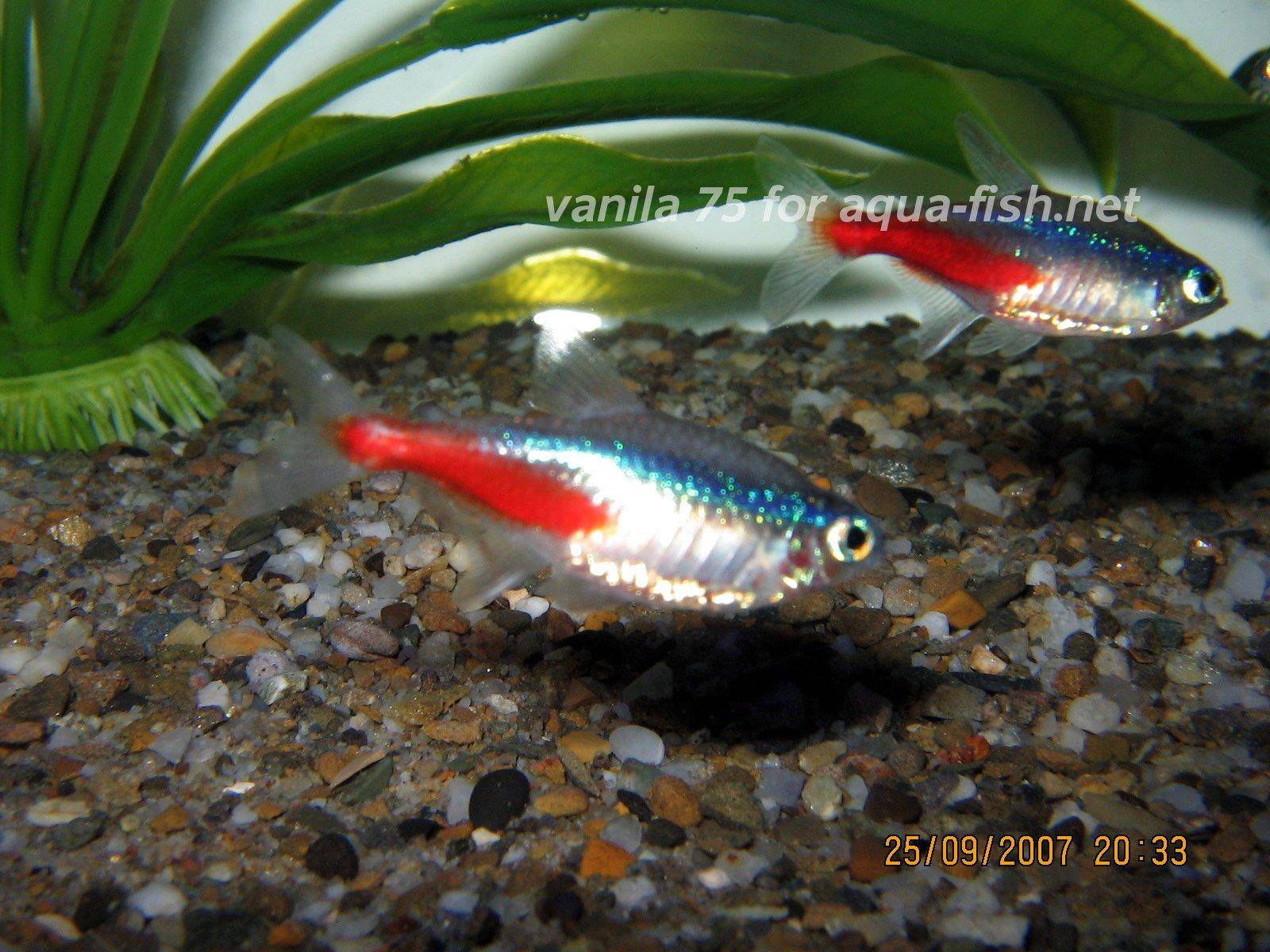
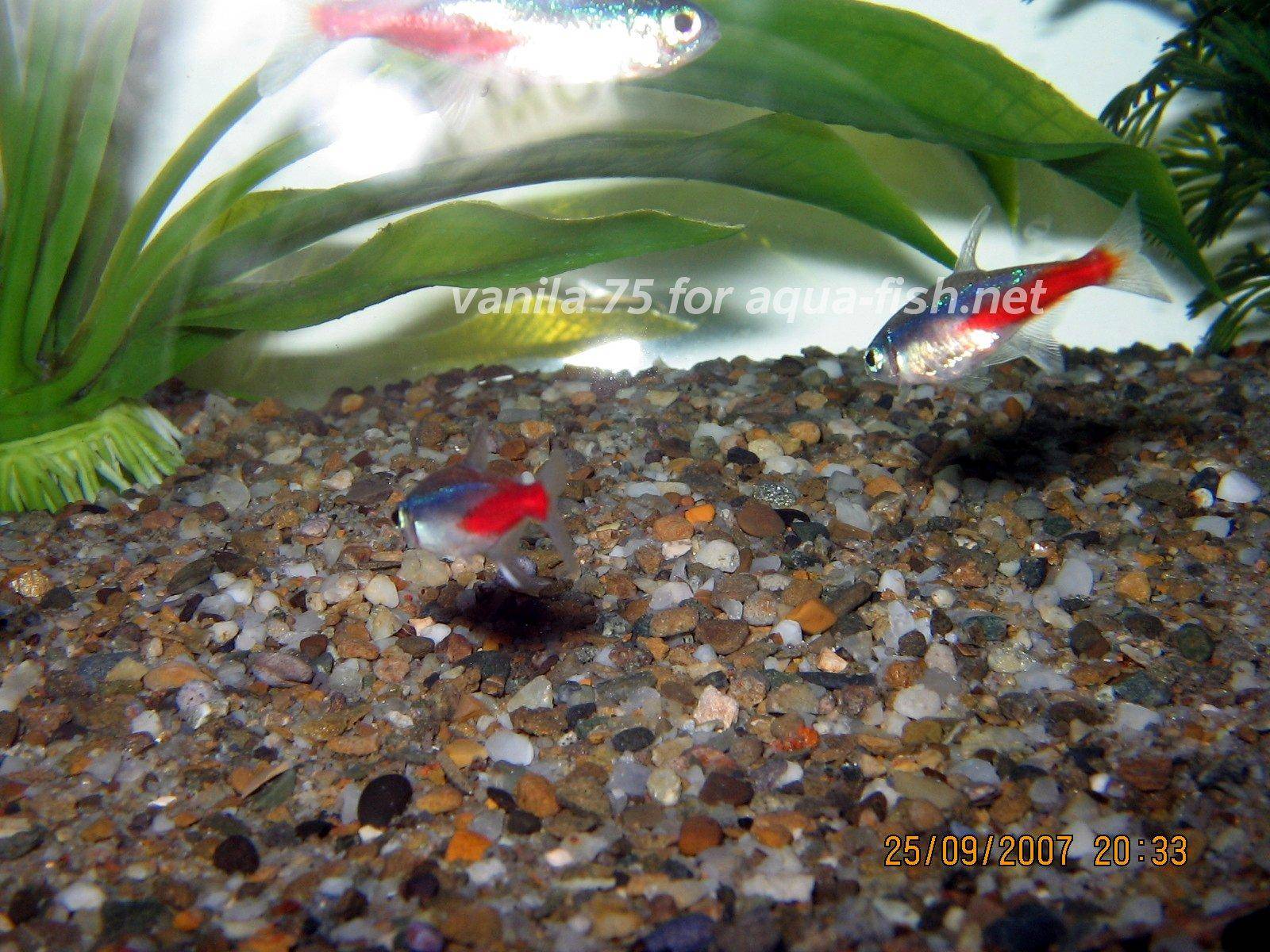
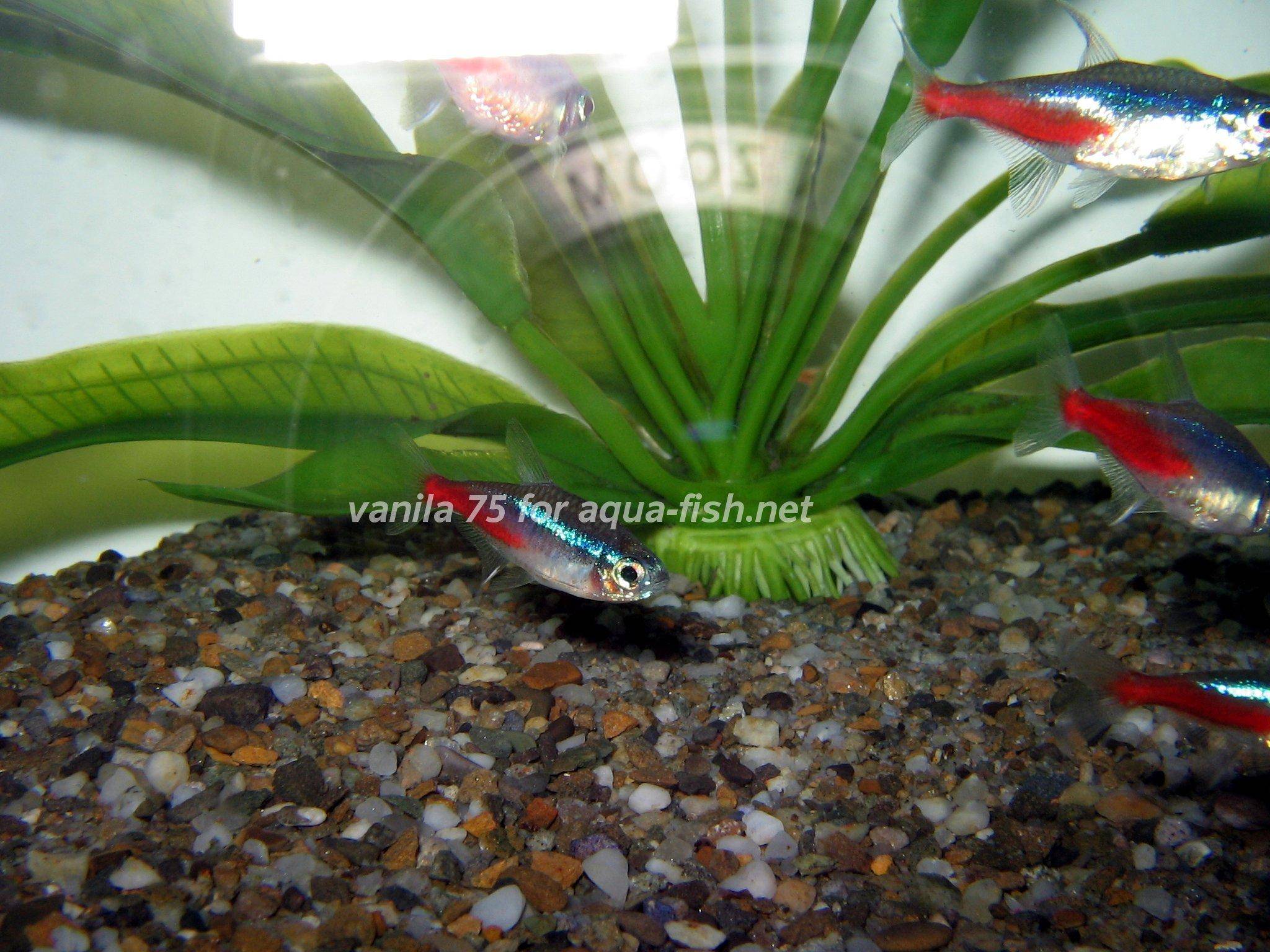
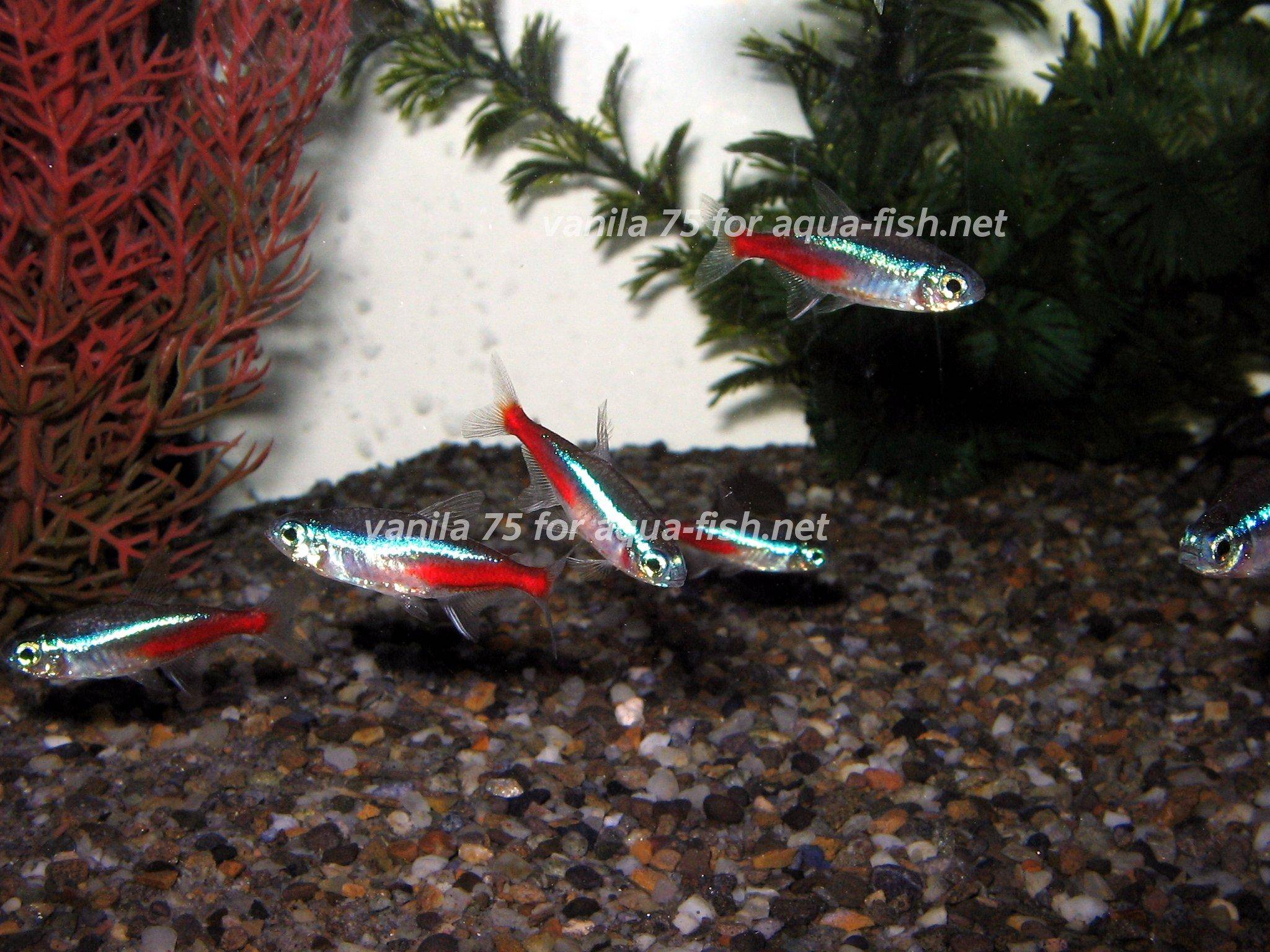
Neon tetras (known under the scientific name scientific name Paracheirodon innesi) belong to the family called Characins, and they’re one of the most known tropical aquarium fish around the world that grow up to 4 cm (1.57 inch) in length, prefer slowly moving waters and love subdued light. They come from South America’s moderate sized rivers, southeast Colombia and eastern parts of Peru, where the water is usually dark-yellow or dark-brown. These fish are peaceful, non-territorial and schooling species that do well in groups of 10 or more, they should never be kept as a single specimen in a tank as they rely on each other to help them settle and alert each other of any danger. It’s important to emphasize this fact as many aquarists are often misinformed, thus their fish suffer. Recommendations such as 3 or 5 Neon tetras per tank should be ignored!
Conditions in the tank
Neutral or slightly acidic water (pH 6.5 - 7) of stable temperature that is somewhere between 20 and 25°C (68-77°F) is acceptable for these fish, general water hardness of 4-14°N dGH (71.43 - 214.29 ppm, 1.43 - 4.29 mEq) is another important value to think of when raising Neon’s. Bear in mind it’s crucial to monitor carbonate hardness since pH is stable when carbonate hardness is 4 or greater. Paracheirodon innesi will tolerate pH within range 5.5 – 7.5, but this value must not vary on a random basis.
Tank setup
For a typical neon tetra biotope the substrate should consist of a sandy bottom and scatter some almond leaves or similar around to give a realistic feel to the tank. Bogwood can be added to help keep the water acidic and this will also release tannins into the water giving it a yellowish tinge. Keep the lighting fairly subdued and add groups of plants but leave open swimming spaces at the front of the tank. Plants that are suitable for a Neon tetra tank are as follows: Tonina fluviatilis, Mayaca fluviatilis, Myriophyllum aquaticum, Heteranthera zosterifolia, Lilaeopsis brasiliensis, Hydrocotyle verticillata, Egeria densa, Echinodorus parviflorus, Echinodorus osiris, Echinodorus latifolius, Echinodorus amazonicus, Cabomba furcata. A display tank is preferred by keepers of these Tetras.
Pieces of bogwood and plants (dead or alive) will help to keep the water acidic, the bogwood will also release tannins into the water which will give a yellowish/brown tint to the colour of the water, providing these conditions should bring out the best colouration from the Paracheirodon innesi, subdued lighting and using a darker substrate will also help for the best possible colouration.
Optimum colouration for these fish is crucial as they are a shoaling fish and will communicate with their colours, if they are kept in unsuitable conditions then their colours will fade decreasing their ability to communicate to each other as well.
Tank size
Even though Neon tetras are very small fish they will still need a tank that is large enough to house 1 inch of fish per US gallon (0.83 Imperial gallon) of water (approximately 0.7 cm – 1 cm of fish length per liter), if you are keeping a large group of these, always bear this in mind. A 5 gallon tank (18.93 liters, 4.16 Imperial gallons) will only be capable of housing 5 neon tetras so such a tank really isn’t suitable; To keep the minimum of 10 fish you will need at least a 10 gallon tank (37.85 liters, 8.33 Imperial gallons). Raising this species in a fish bowl must be avoided unless a bowl is large enough (50 liters, 13 US gallons, 11 Imperial gallons) with plants, rocks and wood that designate orientation points.
Are Neon tetras fish for beginners?
Many aquatic stores sell these as beginners fish but this is a very bad practice as they mislead customers into thinking that they are an easy species to keep and are very hardy. This is just not true, they should never be added to a new tank setup, they should only be added to a tank that is fully cycled and the water has matured for at least two months. Often keepers will buy these fish and check the tank the next morning only to find that some of the neon tetras have disappeared!
If the water chemistry is not stable they can be quickly affected and will die off very quickly, often the bodies are hard to locate and sometimes the dead bodies can even be sucked into the filters due to their small size.
Temperament and Tank mates
Generally, Neon tetras are very shy which is noticeable if you keep only 2 or 3 of them. Roots of this behavior originate from their natural environment, size, position in the food chain - these fish are not predators, instead they try to group themselves in large shoals and hide from predators in roots or fallen wood in the rivers of South America which are naturally full of fallen wood, roots of trees and plants. Such an environment offers a lot of hiding places. If you place a few Neon tetras to a completely empty tank (that's filled with water only), they will suffer which leads to diseases and premature death.
Neon's are compatible with peaceful species of fish that are not a lot bigger than themselves. They do well with Corydoras, other species of the smaller Tetras and Rasboras. They are often seen kept with the incorrect tank mates such as Acara's, Paradise fish, Oscar's and the keepers couldn't understand why they are disappearing with no trace, if they did their homework and researched the species they would know why. Peaceful Pleco's are generally good tank mates for Neon tetras, even loaches such as Yoyo loach, Zebra loach, Horseface loach or Tiger hillstream loach can be kept with these tetras. Guppies, Mollies or Platies can be raised with Neon's too.
Paracheirodon innesi can be even kept with Angelfish or mid-sized South American cichlids, however it's necessary to introduce all species to their new tank as juveniles. It's crucial to understand that Neon tetras are eaten by Angelfish in the wild, so combination of these doesn't have to work in all cases!
If you already run a community tank, feed your fish and turn off lights before adding your Neon's into the tank.
Nutrition - Diet
Firstly, neon tetras are omnivores. They will eat brine shrimp, a good quality flakes, small granules, small live or frozen food, or tubifex. Feeding should be provided at least two times a day, the Neon's only have very small stomachs so only offer them very small meals each time. Only offer them the amount that they can eat in 5 minutes, excess food will rot and spoil the water quality in the tank.
Aquarists are often misled by inexperienced shop assistants and believe that Neon’s eat plants – this is incorrect, your plants are 100% safe with Neon tetras.
Sexing and Breeding
Sexing these fish can be difficult in itself but the females will have a rounder belly shape and looking at the lateral line, the males will display a straight line whereas the females will be slightly bent, this can be seen a lot more clearly if she is full of eggs.
Neon Tetras can be quite a difficult species of fish to breed however they are successful in the fish farms if Asia. In the wild they are prolific breeders but this skill doesn’t seem to happen very often in the aquarium. Usual batch contains 30-50 eggs per spawn.
Set up the breeding tank with an air driven sponge filter and add marbles in the bottom so that any fallen eggs will fall through the spaces. These fish show no parental care and will attempt to eat the eggs if given the chance. A few plants should be added (live or artificial) and ensure that the water is soft and acidic, the pH should be no higher than 6.8. Always use a lid on the tank, spawning Neon's will leap out of the water, you do not want to lose your fish at this stage. There should be no lighting and condition the parent fish on live or frozen foods until the female has started to swell with eggs. Spawning will take place at daybreak, once this has completed the parent fish can be removed and eggs should be stuck to the plants, the tank glass and in the marble substrate.
The eggs will hatch after 24 hours but keep the tank in darkness as the fry are light sensitive and this can bring on shock. They will consume their yolk sacs at first so do not offer them any food initially, once the sacs have been consumed they can be fed on Infusoria or a commercial fry food until they are large enough to accept newly hatched brine shrimp.
Colours and diseases
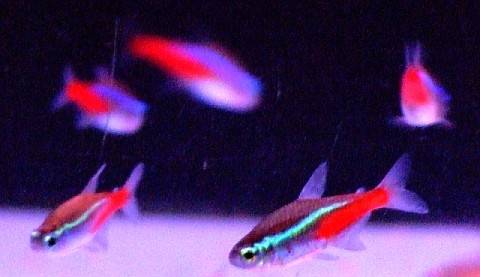
The Neon tetra is of dark olive-green colour combined with the silver-white and red. Usually, they lose the colours during the night hours, because the fish rest and at this time they are vulnerable in the wild so fading makes them less easy for the predators to see. When they become active, which is usually in the morning, the colours come back. If any fish is of poor health or the colours fade during the daytime, it’s the attribute of some disease. Please note, that any dramatic change to their environment could cause unpredictable behaviour or diseases.
Probably the most common disease is called ‘the neon tetra disease pleistophora‘. This disease roots in the microsporidian parasite which enters the fish after consuming some infected material or through open wounds. The major symptoms are restlessness, losing the colours, swimming problems. The only ’treatment’ means removing the sick fish. Diatom filter may reduce the number of parasites in the tank. We have an article devoted to this disease here: Neon tetra disease – symptoms, prevention and forum.
Pictures
Provided by Mihail of Romania.
Additional questions and answers - About Neon tetras
On March 19th 2011 we merged all Neon tetras - related questions from aqua-fish.net/answers with this article in order to put similar topics onto a single page. If you cannot find answer on your questions, feel free to use a form which can be found at the bottom of this page and ask us, please. Some of the below-listed questions may be partially answered on this page already.
-
Why are my neon tetras so shy?
Answer: Neon tetras are a very misunderstood species of fish. In many pet stores they are labeled as ideal for beginners. The neon tetra is classed as a timid fish and should be given hiding places in the aquarium if it feels the need to be out of the limelight for a while.
-
Why are neon tetras so fragile?
Answer: Neon tetras are classed as a timid fish and demand the best water quality in the aquarium. They should never be added to immature tanks.
-
What do you do when your neon tetras lay eggs?
Answer: The plant where are eggs should be moved to another tank (or vice-versa, move the parents and other fish which are in the tank) in order to avoid the fry from being eaten. Then feed the fry Artemia salina.
-
Why do my neon tetras panic when the aquarium lights go off?
Answer: In their natural habitat the neon tetras will look for hiding places at nighttime to escape predation. This instinct is still performed in the aquarium.
-
What water conditions do neon tetra like?
Answer: Neon tetra need slightly acidic, soft water conditions - pH 6.8 and kept at a temperature of 24 °C (75.20°F). They should never be added to a new tank set up as they require mature water to live happily.
-
What level of the aquarium do neon tetras usually live in?
Answer: These fish will swim in all levels of the aquarium, and they love space so a large aquarium with lots of hiding spaces and plants will be appreciated.
-
What size fish tank should I get for breeding neon tetras?
Answer: Neon Tetras do not need a large tank for breeding. 10 gallons (37.85 liters, 8.33 Imperial gallons) will be large enough for this purpose.
-
Why do my tetras chase each other?
Answer: This is their way of playing which means the fish are happy in the tank you have provided for them.
-
Why doesn’t the coloration on my tetras show up?
Answer: This is a classic case of the fish not being happy with the tank environment. When the fish is in full color they are well at ease.
Other webpages devoted to Neon tetras; Outside of Aqua-Fish.Net
- Neon Tetras and Bettas at nippyfish.net!
If you've finished with the article and all comments that can be found below, feel free to visit the following pages, they're devoted to Neon tetras in home fish tanks; Neon Tetra @ AquaticCommunity.Com, Neon Tetra - Paracheirodon innesi @ AquaHobby.Com, Robyn's Neon Tetra Page @ FishPondInfo.Com, Neon Tetra - Paracheirodon innesi @ FishLore.Com, Paracheirodon innesi - Neon Tetra @ SeriouslyFish.Com, Neon Tetra, Paracheirodon innesi @ Animal-World.Com. If any of the links doesn't work, contact us, please!
 Advice on keeping Rainbow Sharks focusing on temperament and tank setup
 How to care for Bala Sharks with details on feeding, breeding and with forum
 How to keep and breed Barbus Tetrazona (The Tiger Barb)
 An article dedicated to raising Black Skirt Tetras in fish tanks
 Breeding Guppies by Kendra Jones
 An article on breeding and caring for Nothobranchius rachovii
 A guide on caring for Cherry barbs with discussions
 Species classified as community aquarium fish
 Fish species (how we divide fish)
 A forum and guide on raising Glass bloodfin tetras
 A guide on keeping Platies with FAQ and discussion
 A guide on caring for Guppies with focus on shapes and patterns
 The Guppy Fish - A guide and forum on breeding and care
 How to care for the Black Molly including breeding and discussion
 How to take care of Kuhli loaches with forum and images
 A guide and forum dedicated to keeping Guppies in aquariums
 An introduction to caring for Killifish
 Keeping Motoro stingray (Potamotrygon motoro) in home fish tanks
 Pictures of the Black Skirt Tetra with Discussion
 Proper Care of Rainbowfish with Feeding and Breeding
 A guide on keeping and breeding Mollies with forum and images
 An article and forum dedicated to caring for Yoyo loaches