Kribensis - Pelvicachromis pulcher - Care, Breeding, Diet & Forum
Quick links - Answers
Advice by Mick, fishkeeper since 1976

Brief Description
This page covers all aspects of raising Kribensis; From diet through tankmates to breeding. You're welcome to share your experiences with us, eventually you can ask questions at the bottom of this page - we will gladly answer!
Kribensis fish are one of the most popular of the dwarf cichlids that many keepers will use to start out in the world of fish breeding. When the fish form a pair they will become prolific breeders, the problem arises, not getting the fish to breed, but where to pass on all of the fry that they will produce.
The name Kribensis actually is the common name for Pelvicachromis Teaniatus, most pet stores have used the common name to sell the Pelvicachromis Pulcher, this is the fish you will normally see in the tanks described as Kribensis. So how did it get this name - Pelva is the Latin for belly, chromis is colour, and Pulcher is Latin for beautiful. This is a very apt name for this beautifully marked fish, especially at spawning times.
Size
As this fish only grows to approx. 4 inches (10.16 cm) it is classed as a dwarf cichlid, smaller tanks are perfectly alright for setting up as a breeding tank. Other common names that the Kribensis has been sold under include Niger cichlid, Purple cichlid, Palette cichlid, and there is also an albino variety that has been bred over the years.
Origin
In the wild the Kribensis is found in the rivers of Nigeria, sometimes in brackish water, they can even be found where the rivers join the Atlantic Ocean. It is not recommended that they are kept in a brackish tank, a little salt may suit them but I have had the best results with freshwater. Another unusual trait with this fish is that it is the females that display more colouration than the males, highly unusual in the fish world.
Body and demands on water
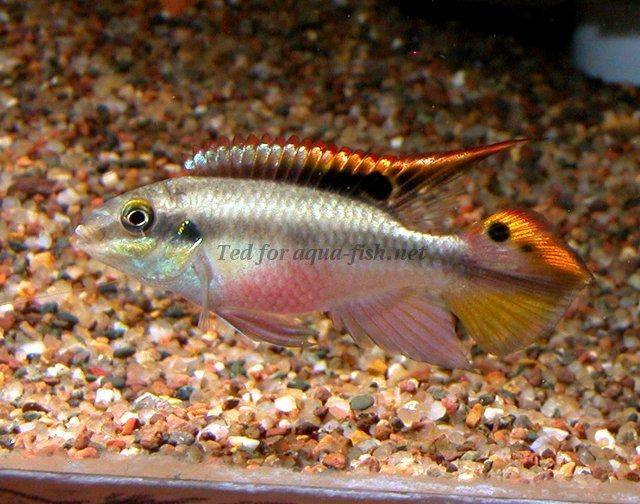
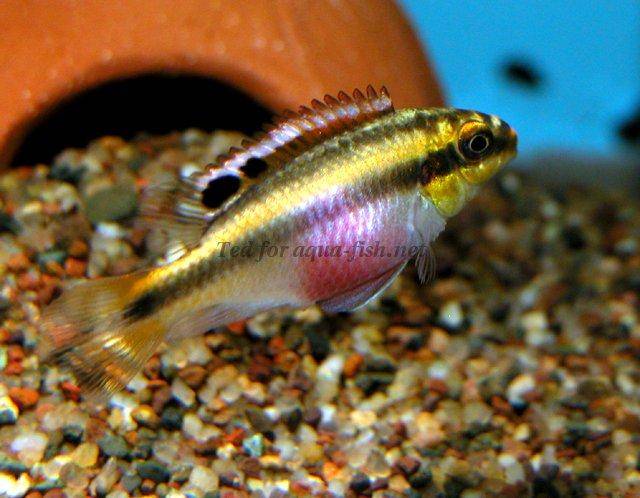
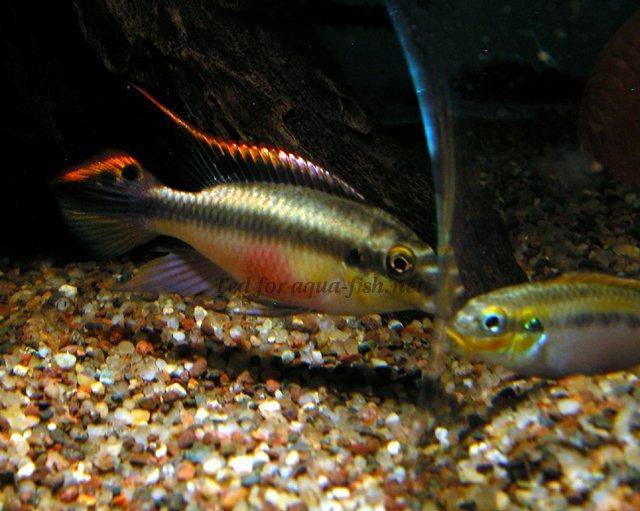
The body colour is a light olive with a dark stripe running all the way along the body from the eye to the tail. The male will sport a pinkish belly, and the females belly should be a dark red colouration. Females may also display a greenish patch on the throat. The fins are dark with dark spots that are outlined by a yellow area; the edges of the fins will also be edged with yellow or orange. The female will always be brightly coloured but the males colouration will intensify from pale markings to vivid when breeding is to take place.
Another reason for the popularity of the Kribensis is its ability to adapt to most water conditions, ideally the pH should be approx. 6.5-7.5, and temperature should be set between 70 - 80°F (~ 21 - 27°C).
For a single pair the minimum tank size should be no less than 24 inches (60.96 cm) in length, a water volume of 20 gallons (90.92 litres, 24.02 US gallons) is the smallest that they should be kept in. The tank décor is mainly a matter of choice, providing hiding places will benefit the fish, but adding braver tank mates will prevent the Kribensis from becoming shy. Plant pots turned on their side or caves added to the tank will definitely induce the fish to pair up, these will provide spawning sites in the future. As with all fish, the water quality should be kept to a high standard with regular water changes.
Dietary needs:-
Kribensis will accept most foods that are offered, flakes and small granules will be eagerly consumed. Live foods like brine shrimp and mosquito larvae are ideal if offered 2-3 times per week, and they are particularly fond of spinach. When they are given food that they really like, they can change colour immediately, showing their approval.
Tank mates:-
Ideal tank mates are other dwarf cichlids, barbs and tetras. Kribensis do have a reputation for being fin nippers so avoid mixing them with fish that have long, flowing fins like Angel fish and Gourami.
Smaller fish may be seen as food by the Kribensis, always try to avoid adding Guppies etc.
Breeding Kribensis:-
Kribensis are monogamous fish, when they have formed a pair they will breed; the best way to achieve this is to purchase a mixture of males and females, letting them pair up naturally. When you manage to get your pair move them straight to a breeding tank. As mentioned earlier plant pots or caves are ideal in the breeding tank, give them plenty of scope to choose their spawning site. Do not be tempted to leave them in the main tank as once spawning has taken place, they will defend their site vigorously.
When they have selected the chosen plant pot or cave they will probably spawn very secretively, the only clue you will have initially is the fact that the female will not be seen for about 7 days, the male will be swimming in a very skittish manner around the tank. The female will lay between 50 - 300 eggs underneath the roof of the selected site; this is achieved by the female swimming upside down for the eggs to attach. The female will do the egg guarding while the male will be on the lookout, defending the territory. Kribensis are excellent parents and will defend vigorously their nest site.
The eggs should hatch after 3 to 7 days and the parents will in a typical cichlid fashion move the fry about in the tank by carrying them in their mouths. Every night the female will find a safe spot for the fry and she will release them into a favoured cave or pot. In the morning the female will emerge and only once she is sure it is safe for the fry to come out, will she allow them to do so. They will swim around the tank keeping in close range with the female who will be always on her guard for signs of threats to her babies. Feeding the fry is quite simple; they will take crushed flake, fry granules and brine shrimp. The parents will normally “blow” the food to them from their mouths.
If the parents eat the first couple of batches of eggs, don’t worry, this is quite normal behaviour for cichlids while they are learning to be good parents.
Spawning will usually take place every 4-5 weeks so the previous batch of fry should be moved into their own rearing tank before then.
My opinion is that these are wonderful fish to keep, anyone new to breeding fish will be fascinated by their behaviour during spawning and the success rate will inspire them to have a go at breeding other species.
 Advice on raising and breeding Discus fish with forums
 An article dedicated to raising Blue Rams, their breeding and feeding habits
 How to breed Platies in aquariums
 The Swordtail Fish - Caring and breeding in aquariums
 An article on raising New World cichlids with discussion
 FAQ and answers on raising the Discus fish in aquariums
 How to raise wild Discus in fish tanks
 Selecting Discus
 An ultimate guide on raising Discus focusing on breeding, diseases and compatibility