The Guppy Fish – A guide on breeding, diet, sexing, care & forum
Quick links - Answers
- Breeding
- Care
- Regulating population
- Size
- Way of breeding
- Lifespan
- Diet & feeding
- Living out of water
- Age of sexual maturity
- Amount of food per fish, per day
- Space demands
- Ideal temperature
- Shape of a female Guppy
- Ratio of males vs. females
Guide by Susan, Professional breeder of aquatic fish since 1996
Brief Description
This page is an ultimate guide on raising Guppies with answers on common problems, pictures and care-related information! If you'd like to share your own experiences regarding keeping Guppies let's check the bottom of this article where you can find a form for those who are willing to share experiences, tips and information - or ask questions too! Also visit the following pages: Guppy - Poecilia reticulata profile with pictures and forum, FAQ, Care and Origin, Raising Guppies, Endler's guppy.
The Guppy fish is probably the most famous species of aquarium fish in the world, and is also known as one of the low-cost fish in shops even though some forms may be expensive. Small, beautiful, peaceful, lively, curious and hardy, there are many colourful variations (see the pictures below) that can be collected and easily bred. This species is one of the best choices for beginners, especially children. However, like every fish kept in captivity, these fishes also require proper care and conditions (read below to find out more). Although care of Guppy fish is almost effortless, one shouldn't underestimate it as Guppies may suffer from diseases too!
Sexual dimorphism of guppies
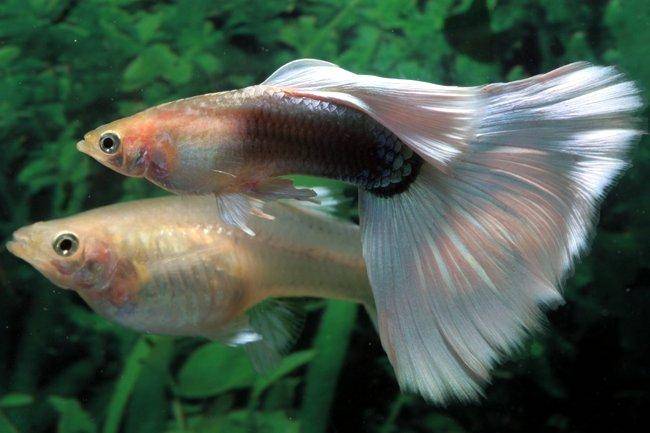
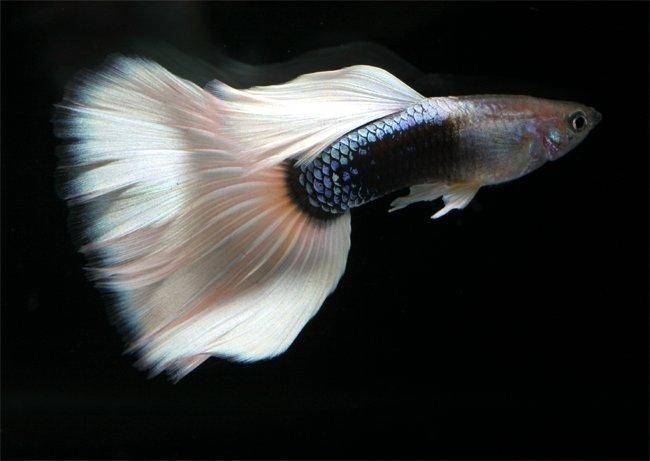
Females are much larger and rounder than males, they even do not look like the same species. Unlike females which are dull grey, males are very colourful and have wide fins. There are many types of Guppies and by breeding you can even create new variants. One of many variants is the Endler's Guppy (link). Once adulthood has been reached, in size they vary within this range: 4.0 - 6.0 cm (1.6 - 2.3 inch).
Information about feeding – Proper diet
The Guppy can be fed a wide variety of foods (flakes, Spirulina, lettuce, bloodworms, spinach, freeze dried foods, mosquito larvae). These fish will welcome almost everything, however one shouldn’t feed them low quality foods because it negatively affects health and lifespan of fish – always go through ingredients on back side of package, never buy food that contains incomplete list of ingredients. Low quality foods are known to list only 40%-50% of their ingredients, the rest stays unknown to the keeper. Guppies have small stomachs and can only consume a little bit of food at one feeding. By the way, it is entertaining to watch them eat larvae, which are almost as big as Guppies. They eat larvae like big spaghetti. It is recommended to feed them in small amounts (something that they eat in two-three minutes) at least 3 times daily. When I kept these wonderful fishes, I used to give them food two times a day. Bear in mind that like other fish, Guppies will too eat anything tasty that can be found in a fish tank including eggs and fry. Mine used to eat eggs of Panda Cories (if eggs are in a visible place, then they're not safe). It’s OK to let your fish starve one day per week as this procedure helps them to empty digestive system which lengthens lifespan of any fish, not only Guppies.
Breeding guppies and caring for the fry
Guppies are prolific breeders, livebearers, which means they breed almost non-stop if a male and female are left together. Both parents have to be adult, healthy and not too old (expected lifespan of Poecilia reticulata is 2-3 years, thus female shouldn’t be older than 2 years in order to reproduce) in order to breed successfully. Guppy female does mature when being approximately 3 months old, males use to mature a little sooner. The males will perform a courtship display in front of the female by spreading their fins and curving their body. Once the female is fertilized, it’s going to take between 28 and 30 days until gestation period ends and the female gives birth. Her belly will grow rapidly during gestation period, in the end she might look boxy. Additionally, gravid spot will be visible on female once she’s pregnant. Bear in mind that Guppies that are close to giving birth prefer slowly moving water, hide a lot and spend a lot of time laying on substrate or plants. Some females may refuse to eat when birth is imminent.
Once female gives birth, the fry can be left to care for themselves immediately after they’re born. Unfortunately, the guppy fry are a delicacy to most fish, therefore add floating plants such as Lemna minor or Pistia stratiotes into your aquarium in which newborns can hide. Even parents of newborns will consider them food! It’s a good idea to separate newborns from other fish, setting up a dedicated tank for fry is a recommended measure, however make sure water parameters (pH, hardness, temperature) are same in both tanks – the “original” one and the “fry” one. Otherwise you’re going to increase their mortality rate as newborns are sensitive to sudden and unexpected changes in water chemistry.
These fish will over breed if their population isn’t controlled, always think about before purchasing Guppies! Say there are 2 females in your fish tank, each of them is capable of producing 20 newborns per month - in 5 months you'll have 200 Guppies in your tank! Inbreeding must be avoided at all costs! Many fish keepers raise Guppies as feeder fish for South American cichlids, this might sound too drastic to lots of aquarists, however using them as feeder fish is a perfect way how to eliminate over breeding.
Another important aspect of raising Guppies is their ability to store sperm for months. It isn’t unusual to see a female fish giving birth even 6-8 months after she lives separately from males.
The tank, tank mates and caring for the guppy fish
Guppies require fairly warm temperatures (23-24 °C, 82-84°F), but they can live in water between 19.0 - 29.0°C (69 - 86 °F) as long as pH is stable anywhere between 7.0 and 8.5. Ideal general water hardness for Poecilia reticulata is 12.0 - 18.0 °N (214 - 321 ppm, or 4.29 - 6.43 mEq), however they’re known to be able to live in softer water too. A vegetated tank is perfect for raising Guppies as it not only increases survival rate of newborns (they have a place to hide), but it also imitates their natural environment. Plants such as Vallisneria spiralis, Echinodorus amazonicus, Cabomba furcata are fantastic choice for Guppy tanks as they create beautiful sceneries if grown properly. Mentioned species grow quite large, so they’re suitable as background plants.
Since guppies are very social fish, they shouldn’t be kept alone. Raising them in a community tank with peaceful fish is OK too, however Guppies are known to be fin nippers. Fish with attractive fins (Siamese fighting fish for example) may suffer if kept with Guppies, thus avoid raising such species together. Only fish that know how to strike back in case they’re harassed should be kept with these active livebearers because Guppies often follow other fish and try to “play” with them.
Since this species breeds like rabbits, good ratio of males and females is 1:3.
Tank mates that should be avoided:
- Gouramis
- Paradise fish
- Siamese fighting fish
- Acara’s, Jack Dempsey cichlids, Texas cichlids and almost all Central/South American cichlids
Good tank mates for Guppies include:
Since Guppies tend to live happily in a tank with more than 10-15 inhabitants, a reasonably sized fish tank is necessary for raising them. I would never recommend to put Guppies into a tank of 20 litres (5.28 US gallon, 4.40 Imperial gallon) or less. Actually, a 20L aquarium will never contain full 20L of water thanks to gravel, filter, driftwood, and the fact that no fish tank is filled from top to bottom. Instead, at least 40 litres (10.56 US gallons, 8.8 Imperial gallons) are required for about 10-12 Guppies. One specimen will do just fine in a 5 litre tank which is 1.32 US gallon or 1.09 Imperial gallon.
Never put a Guppy into a small fish bowl! Fish bowls are known to cause orientation problems and fish in small fish bowls use to die in a short time! If for some reason there is no chance to avoid a bowl, try to get one that's as big as possible - Preferably 60 litres (15.85 US gallon, 13.20 Imperial gallon) or bigger. In addition, create rows and use decorations such as driftwood or caves in order to help the fish to orientate.
Diseases of guppies
Just like other fish species, Guppies may suffer of diseases as well. It’s a general rule that applies to all fish and plants - The better water quality, the higher chances of keeping healthy Guppies. It's important to understand that stress is one of the most important factors in development of any disease. If your fish feel uncomfortable it will lead to a disease no matter whether it’s a fish, or any other animal. Since there is an article devoted to the most common diseases in home aquariums, feel free to visit it: aquarium fish diseases. When keeping Guppies, maintain the water of high quality (free of ammonia, chlorine, chloramine and related substances, pH of 7 at least, appropriate hardness and carbonate hardness, stable temperature) and you'll avoid almost every disease.
Selling or donating the fish
Selling the fish can be a little tricky as many stores won’t accept home-bred fish, thus selling them in a local show is more likely to happen. If you have too many Guppies, rather advertise in your local newspapers or local internet forums.
Additional information and knowledge about guppies
Many people visit aqua-fish.net in order to ask about their Guppies as can be seen under the article, therefore we’ve compiled the most asked questions and answered them here:
Many people ask how to control guppy population. There are a couple of easy solutions; Using a divider, separating females from males (meant as keeping them in two different fish tanks), selling fish to your local pet store, using Guppies as feeder fish, introducing a natural predator that will eat fry, or giving Guppies to someone who keeps, say, Oscar fish, Jack Dempsey Cichlids, Paradise fish or so.
As Guppies aren't very good jumpers, it is not likely to find them on the carpet or floor, but anyway people ask how long can a guppy live out of water. The more people, the more answers. Some specimens could live 10 minutes, while other only 5, and some could make it to an hour. The problem is that the longer a Guppy is out of water, the more damage it causes. A specimen may survive 10 minutes, but you never know if such a fish is going to make it through the night. In my experience anything up to 5-6 minutes should be safe. Use a lid in order to avoid such issues.
Fishkeepers also ask how much water does a guppy need. There is no correct answer, but keeping 1 Guppy per 1 liter isn't good. As mentioned already I recommend at least 5 liters (1.32 US gallon or 1.09 Imperial gallon) per Guppy.
Pictures of guppies
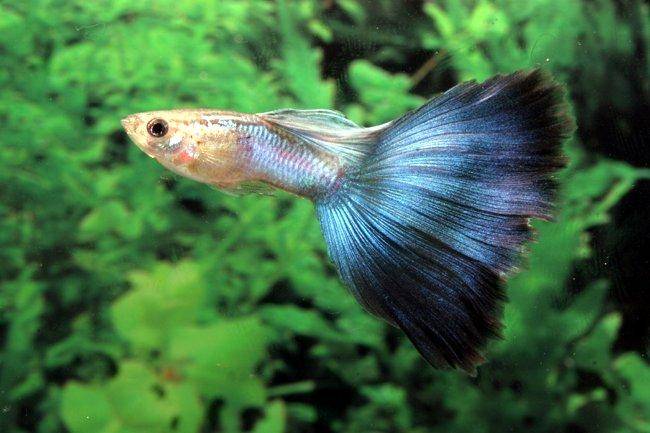
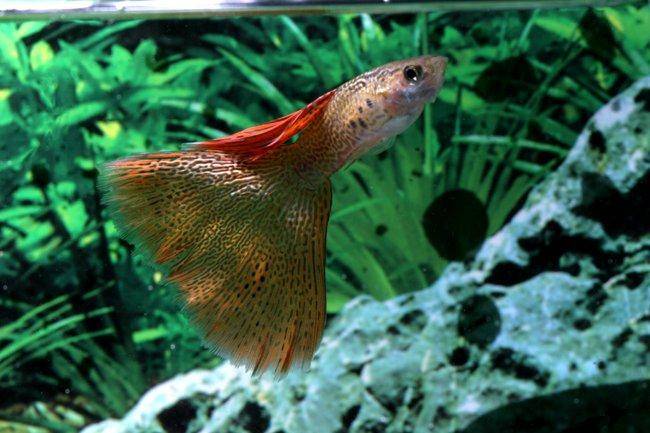
Thanks a lot to William Yen who has allowed us to use the pictures. There are males on all pictures except for the first one. There is a female on that image too behind the male; The female can be differentiated easily because males have beautiful long fins and are coloured. Unlike males, females have big bellies and aren't coloured that nicely. Females are also bigger.
This article is available in German language too. Der Guppy
Other pages devoted to guppies within Aqua-Fish.Net
Other webpages devoted to guppies (outside of Aqua-Fish.Net)
You're welcome to ask questions if you haven't found answer in the above-shown article or below-shown comments, simply check the bottom of this page. Naturally it's also alright to visit other websites that offer quality information about Guppies; Guppy Fish @ AquaticCommunity.Com, Guppy, Fancy Guppy @ FishLore.Com, or Poecilia reticulata - Guppy @ SeriouslyFish.Com. If any of the previously mentioned links doesn't work, let us know, please.
 Advice on keeping Rainbow Sharks focusing on temperament and tank setup
 How to care for Bala Sharks with details on feeding, breeding and with forum
 How to keep and breed Barbus Tetrazona (The Tiger Barb)
 An article dedicated to raising Black Skirt Tetras in fish tanks
 Breeding Guppies by Kendra Jones
 An article on breeding and caring for Nothobranchius rachovii
 A guide on caring for Cherry barbs with discussions
 Species classified as community aquarium fish
 Article and forum on caring for Neon tetras including diet and breeding tips
 Fish species (how we divide fish)
 A forum and guide on raising Glass bloodfin tetras
 A guide on keeping Platies with FAQ and discussion
 A guide on caring for Guppies with focus on shapes and patterns
 How to care for the Black Molly including breeding and discussion
 How to take care of Kuhli loaches with forum and images
 A guide and forum dedicated to keeping Guppies in aquariums
 An introduction to caring for Killifish
 Keeping Motoro stingray (Potamotrygon motoro) in home fish tanks
 Pictures of the Black Skirt Tetra with Discussion
 Proper Care of Rainbowfish with Feeding and Breeding
 A guide on keeping and breeding Mollies with forum and images
 An article and forum dedicated to caring for Yoyo loaches