The Flowerhorn fish - Proper care, Breeding, Pictures & Forum
Quick navigation
Expert Advice by Jan, keeping fish since 1995

Brief Description
This page is an ultimate guide on raising Flowerhorns with plenty of information from fish keepers, forum, pictures and answers including how to enhance hump growth! However we also have another page devoted to the Flowerhorn fish and you should visit it too: Flowerhorn profile with forum. Both, this page and the link are worth reading especially when you want to learn from others. We'd love to hear about your Flowerhorn too, so use a form at the bottom of this page once you're finished reading this article, please!
Introduction
The Flowerhorn fish is also known with the Chinese common name Hua Luo Han; this fish does not exist in nature but it is a hybrid result of various cross-breeding of South America cichlids, in fact it can be listed under the Cichlasoma genus, even if the starting breeders are unknown, the most of people think about Cichlasoma trimaculatus, C. Festae, Red Parrot cichlid, Jingang and other fish.
Information about care
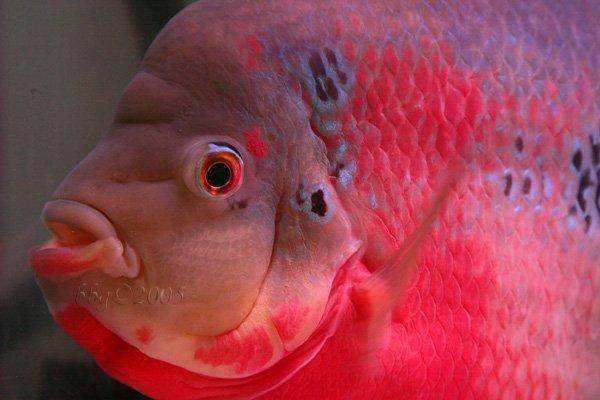
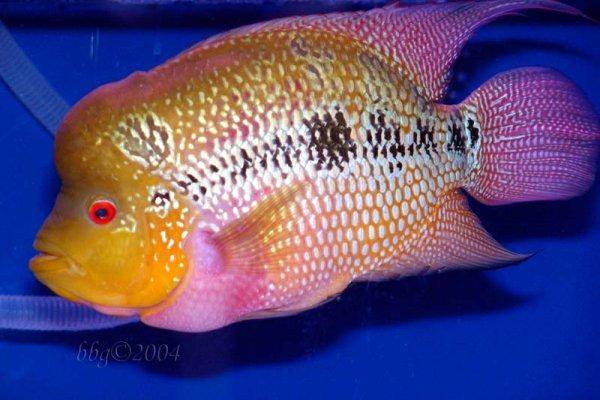
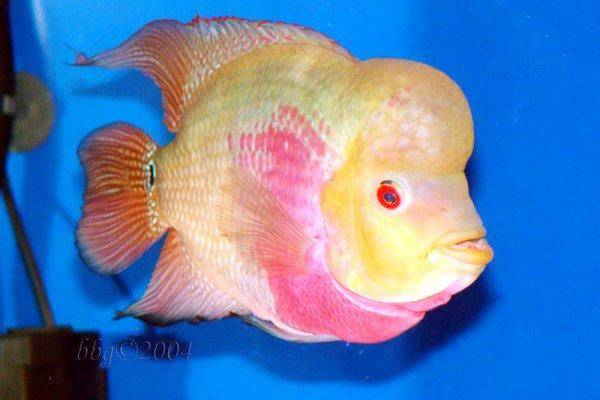
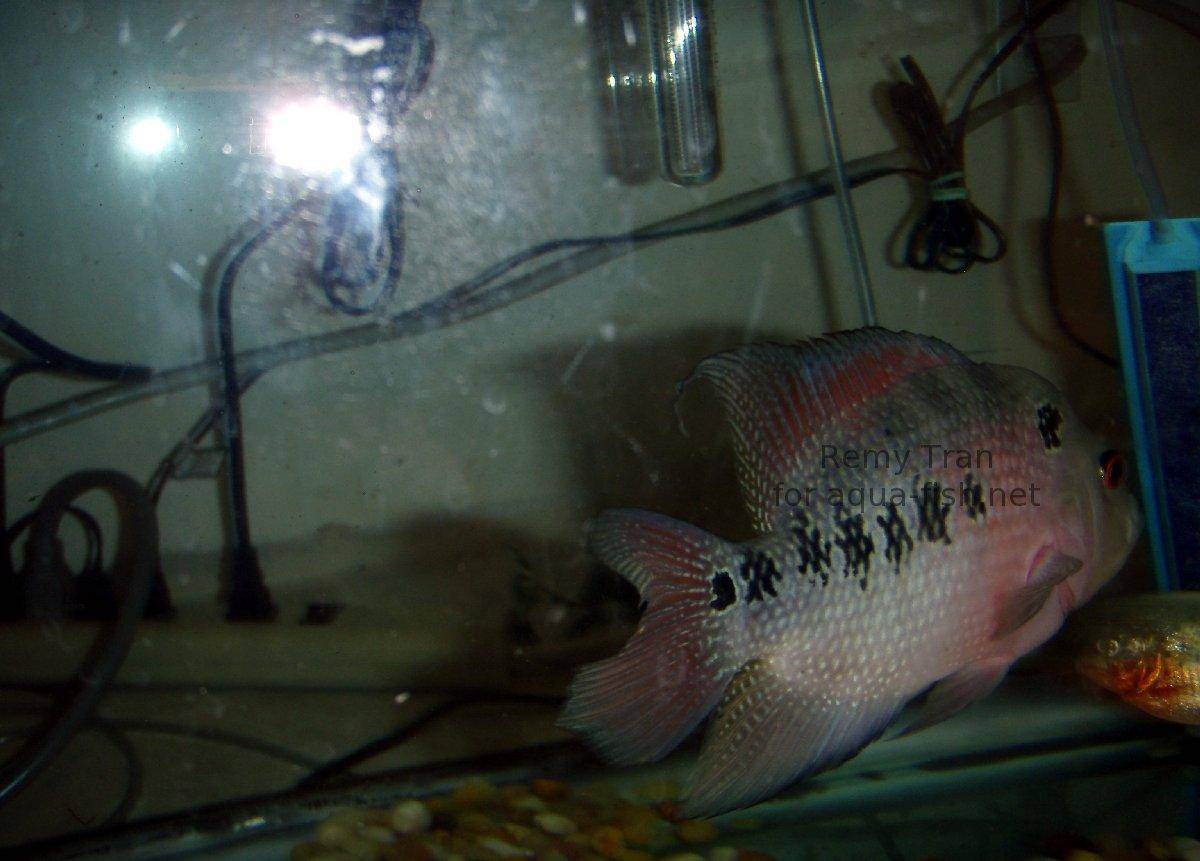
Flowerhorn cichlid is a big fish with compact body, it can reach 30 cm (11.81 inch) in length and sometimes can grow even bigger. Intensive breeding has created a very peculiar fish that is becoming really famous and relatively common in the last few years; moreover breeders keep on trying to improve the fish qualities focusing on bigger hump on the head, new and better colours, wider body and fins, more peculiar black marks on the body, without the employ of chemical and artificial factors. For the importance of appearance, a good Flowerhorn must follow a standard that defines various aspects of its body:
- General body: the fish body must be oval and thick, with full belly and stomach; some new variants have anyway a more rounded shape.
- Hump: the hump on the forehead should be big and well proportioned to the fish size.
- Black marks: it is important that the marks are thick and well defined, this is one of the principal characteristic of Flowerhorn, anyway some new varieties do not give too much importance to them.
- Overall Colouration: the most common Flowerhorn have a predominant red colouration, anyway every colour should be bright and well defined.
- Scales: the entire body should be covered by light blue or green scales.
- Fins: both tails and fins should be widely spread the most of time.
Aquarium set-up information
Due the big size they can reach, Flowerhorn need big aquarium with a lot of free space for swimming; a 200 liters (52.83 US gallon, 43.99 Imperial gallon) tank is the minimum you can offer to an adult fish to let it live healthily. It is a really strong fish and can live in different water conditions without having problems, anyway it is important to provide a temperature between 25°C (77°F) and 30°C (86°F); pH value is also important, because acid water can tone down fish colours and make it sick, the ideal condition is a light alkaline water, with a pH between 7 and 8. Moreover it is necessary to avoid sudden condition changes of temperature and chemical values, because they can make Flowerhorn being more sensible to sickness like bacteria attacks.
Water filtration is really important because this big fish produces lots of refuses that end increasing nitrite and nitrate levels in the water. You can choose both internal and external filtration, even if the second one is preferred to leave more free space to the fish. The biological part must work properly, so be sure to have a well activated aquarium before to house a Flowerhorn cichlid.
Take also a look to the water current, an excessively strong one can damage the fish, anyway it is important that a slow movement is present, because it oxygenates the water, and avoids that the water heats only near heater.
Tank decorations are important to make the fish feel quieter. Use a layer of fine gravel and be sure that rocks and woods are stable and do not risk to fall easily on the fish; be sure, as well, that all the decorations do not make the tank cleaning too much difficult. Live plants are important for filtration and oxygenation, anyway choose strong plants like big anubias, because any Flowerhorn cichlid use to dig a lot; you can also use plastic plants, even if they are not useful and you can risk that the fish accidentally eat them.
Being big and aggressive is better not to house it with other fish species, specially if they are smaller. While if you plan to house more than one Flowerhorn, provide a big tank and divide it with accessories to let fish divide the territory; to avoid fights it is recommended not to keep more than two or three fish together in the same tank.
Pictures
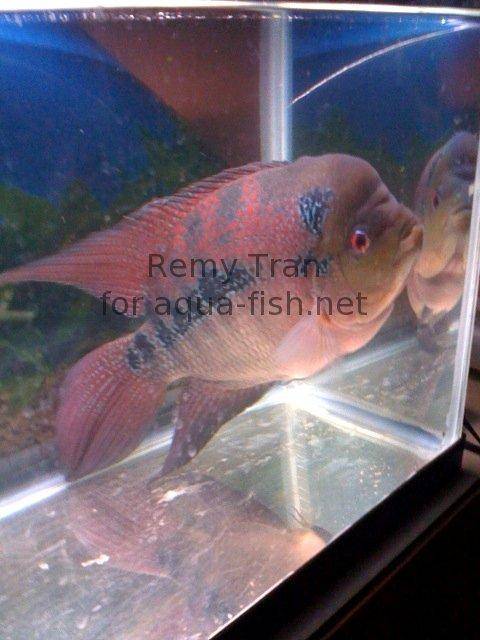
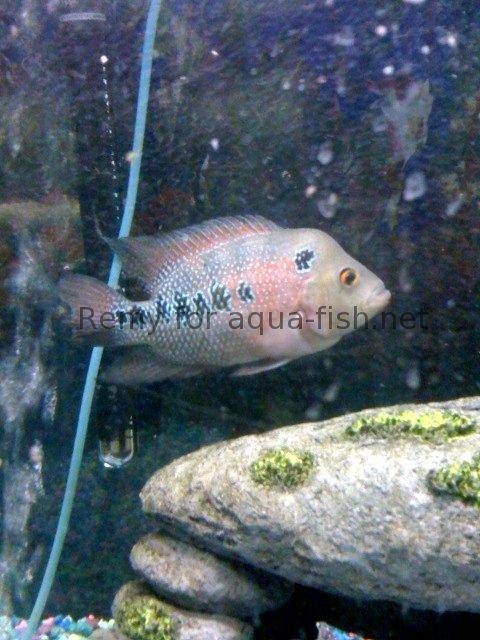
Feeding
Flowerhorn like similar sized fish, astronotus ocellatus for example, need a live food integration to be healthy and in shape. Their diet can consist of live food, frozen food, and standard dry fish food. The live food should be of good dimension, or the fish could not notice it, earth worms and big meal worms or wax worm are accepted; moreover you can give small fish, Poecilia reticulata could be a good choice since the high number of fry they spare monthly. Remember to feed every live food you choose, and in case of live fish be sure they are healthy.
Frozen food is another good solution, especially when you do not have the live one. Young Flowerhorn usually eat chironomus, brine shrimps and other frozen fish foods, while older ones could not notice them; at their place you can offer frozen fish for human use, you have a great choice, anyway if possible get freshwater fish and avoid the sea ones.
Both live and frozen food can pollute the water, so be sure that Flowerhorn eats all the given food in 5 minutes maximum, in case of rests remove them fast; for this reason it is better to have an aquarium set up that allow you to clean fast without needing to move objects.
Dry standard fish food is a good complementary option, especially if it is of good quality. You can find special food produced for cichlids that usually consist of big pellets that Flowerhorn like.
A Flowerhorn cichlid should be fed two times a day, everyday, anyway be careful with the quantities and avoid to overfeed it, reducing the food amount specially if it is really rich of nutrients.
Breeding and care for the fry
Sexing Flowerhorn is quite easy, especially when they have reached the length of 10 cm – 12 cm (3.94 - 4.72 inch). The anal pore of the fish has a V shape in case of males and a U shape in case of females. Moreover females tend to have a smaller hump when adults.
Being cichlids their reproduction can be similar to the cichlasoma one. The female lays eggs on a flat surface, like a rock or the aquarium glass and take care of them, while the male keeps other fish away. After 3 or 4 days the fry hatch and parents take care of them moving in more secure hiding places. You can feed them with just hatched brine shrimps and other specific food for fry.
Breeding is not so easy because female can be easily stressed or worried and ends up eating her eggs, anyway if the environment is quiet and the parents are healthy reproduction is possible.
Special thanks goes to Bien Gutierrez who has allowed us to use his picture.
More pictures of Flowerhorns
Copyright note: This article is originally written by Michela Ferretti. Aqua-fish.net owns the full copyright of this article.
Further reading about Flowerhorn cichlid
If you're finished with the article and comments that can be found below the sponsored links, you're welcome to visit the following pages too; They're on different websites, but are definitely worth reading. Flowerhorn Craze @ FlowerhornCraze.Com (it's a forum), Flowerhorn Cichlid @ Animal-World.Com, Flowerhorn Cichlids @ AquaticCommunity.Com, Flower Horn Information @ Flower-Horn.DE, Flower Horn Cichlid @ AquaHobby.Com, Flowerhorn Cichlid Caresheet @ FishKeeping.Co.UK, The Flowerhorn - A Controversial Aquarium Fish @ FishProfiles.Com. If any of the links doesn't work, contact us, please!
 Advice on keeping and caring for Arowana's in home aquariums
 An article and forum about keeping Koi carps
 Caring for Tilapia fish in aquariums
 A guide on raising and breeding Electric blue haps with forums
 Oscar fish - A guide on raising and breeding
 A guide on caring for the Pacu fish including discussion and images
 A guide on raising Glass catfish
 An article about raising and breeding Flag acara's - Laetacara curviceps
 Piranhas as aquarium fish - Care, diet, answers and forum
 Raising the Red Belly Piranha with large forum and pictures
 A guide on caring for Tropheus fish when raising them in fish tanks