Angel Fish - Detailed care, Breeding, Raising fry & Forum
Freshwater Angelfish Pictures


Saltwater Angelfish (click to get information)

Quick navigation - Answers
- Lifespan
- Mating
- Growth rate
- Adult size
- Space demands
- Sexing
- Tank size
- Habitat
- Eating habits
- Cleaning a tank
- Aggression and compatibility
- Newly added Angelfish
- Definition
Expert Advice by Jan, keeping fish since 1995

Brief Description
This page is devoted to raising freshwater Angelfish (we have pages dedicated to saltwater Angelfish too; continue reading) and contains hundreds of answers! Some answers can be found directly in the article and some answers are located within the comments under the article. We'd love to hear about your Angels, so submit your story at the bottom of this page! Also visit the following pages too (they will open in new tab/window): Breeding Freshwater Angelfish, (another kind of Angelfish) Pterophyllum leopoldi profile, Pterophyllum scalare profile and forum, (again, another kind of Angelfish) Pterophyllum altum, Tim's article on breeding and saltwater Angelfish link is: Keyhole Angelfish - this profile offers links to other marine angelfish!
Introduction and short history
Angelfish (Pterophyllum scalare) are popular tropical freshwater aquarium fish, it’s a pleasure to take care of them, and additionally they are considered one of the most beautiful species of tropical freshwater aquarium fish. Angels often look outside their tank, they may react to various stimuli such as hands in an aquarium, persons standing nearby, and each specimen has its own personality. This species is one of the first fish which were transported from South America to the rest of the world, they were brought to Europe around 1820 and they were bred in captivity for the first time in 1930 in the United States. Angelfish are highly demanded and are for sale in almost every pet store, however there are many misunderstandings and mistakes made by aquarists including lack of knowledge, compatibility issues or ignorance, so let’s explain how to look after these fish properly.
Habitat
Native environment for these fish is the Amazon River in South America, Angels are to be found in bulrushes where they can find shelter. They grow and live in large shoals but this fact doesn’t mean that they can’t swim free especially if kept in an aquarium, ideal number of Angels in a single fish tank is 6-7. However not all aquarists own a 400 liter tank (105 US gallons, 88 Imperial gallons), thus raising 2 or 3 specimens in a community or dedicated tank is acceptable. The Amazon River is known to be a home of vegetation which these fish use for hiding purposes, so it’s wise to grow live plants such as Alternanthera rosaefolia, Echinodorus amazonicus, Echinodorus grandiflorus, Echinodorus schlueteri, Ludwigia helminthorrhiza, Ludwigia inclinata, Vallisneria spiralis, Vallisneria gigantea in your aquarium. Naturally Angels must not be kept in the same tank with predators which could hunt, kill or injure them (more to be found in the “Tank mates” paragraph). Actually in the wild Angelfish’ flat bodies allow them to hide in plants quickly in case there’s a predator hunting them.
Fish tank setup and care
Basics: The ideal pH for these fish is between 6.0 and 7.0, temperature should be around 25°C (77°F), the general water hardness of 4-12°N dGH (71.43 - 214.29 ppm, 1.43 - 4.29 mEq) is the best range. Not only these values are ideal, they should be also constant – pH must not vary, changes in general water hardness shouldn’t exceed 1°N dGH (17.86 ppm, 0.36 mEq) per week, and high temperatures may result in premature death of the fish.
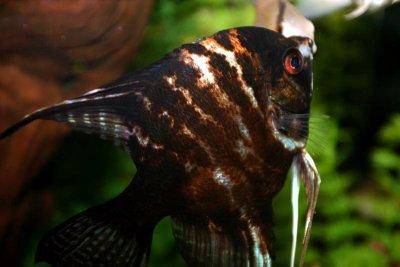
As mentioned already, Angelfish need a large tank, preferably 40 liters (10.5 US gallons, 8.8 Imperial gallons) per specimen which is natural as these fish grow quite big and tall. Less space per specimen isn’t recommended as adult males may be territorial towards each other especially if females are present in a tank. In addition this species will swim vertically and their fins would degenerate in case height of the tank doesn’t exceed 40 cm (15.74 inch), there are known cases when Angels even stopped growing in small aquariums. The minimum height for an Angelfish tank should be 50 cm (19.68 inch) as some space is required for substrate, moreover there’s a gap at the top between surface and lid. After all a tank that’s 50 cm (19.68 inch) tall offers approximately 40 cm (15.74 inch) for vertical swimming, this must be taken into consideration when planning such an aquarium! Lid (tank cover) is a necessity as these fish can jump out of the tank although they don’t tend to jump too often. A small gap of 2.5 cm (1 inch) is sufficient for them to jump out. Bear in mind that Angelfish can be very territorial towards each other, they use to get along much better if kept in a group rather than if kept in a small pack, say of 3 specimens.
As written above, plants are crucial to keep your Angelfish happy. Not only they improve water quality and aerate water, plants are used for laying eggs – especially plants with large leaves. Plants will decompose various debris including excrements, they also hinder growth of algae, and plants serve as hiding spots for newly hatched fish. Newborns are easy targets without having opportunity to hide themselves in shelters! Amazon sword plants (Echinodorus) should be grown in an Angelfish tank.
Even though we recommend 40 liters (10.5 US gallons, 8.8 Imperial gallons) per specimen if raising Angels in ordinary community tanks, breeding tanks must be larger because newborns produce excrements, there’s usually more uneaten food, and filtration isn’t that effective since the recommended filtration system for a breeding tank is a sponge filter. Sponge filters can be highly effective, but external canister or HOB filters are definitely better in terms of water quality.
A short summary: An Angelfish tank shouldn't be smaller than 100 liters (26 US gallons, 22 Imperial gallons), a group of 6 of these fish should be given preferably 400 liter tank (105 US gallons, 88 UK gallons).
Food and feeding
Angelfish prefer flakes over granules or pellets, however diet of your fish must not be monotonous, therefore offer them a wide variety of foods including frozen larvae, worms or insects (live should be preferred, frozen food must be defrost before offered to the fish). Brine shrimp or Daphnia are too loved by these cichlids as much as fry of Guppies, Swordtails or Mollies will be eaten if left with Angels. Additionally offer your fish dried foods, however don’t base the diet on dried foods as these may contain lower amounts of proteins and other important substances. It’s a widely known fact that the dried food contains less proteins than raw or frozen worms/larvae, so make sure that especially juvenile specimens are fed on high-protein diet. High-protein diet is crucial when breeding these fish as they’re known for producing more eggs if fed properly (the number of laid eggs and frequency of reproduction also depends on temperature, more to be found below in the paragraph named Breeding).
Angelfish aren’t messy eaters, they usually eat only a little and should be fed once or twice a day. As they’re not the smallest fish available, their stomachs are big enough to store enough food – Adult Angelfish can survive even 2 weeks without food, however you shouldn’t let them starve for over a week. Juvenile specimens should be fed two or three times a day, naturally young fish shouldn’t starve as it could negatively affect their growth rate and their health.
Amount that can be eaten in 4-5 minutes will keep them full for a day.
Video - Feeding Angelfish frozen black mosquito larvae
Feel free to download our video showing how Angelfish go after black mosquito larvae: download by clicking here (approximately 55 MB).
Suitable tankmates
Angelfish are good tank mates for many tetras, some of the most suitable ones are as follows:
- Black skirt tetra - Gymnocorymbus ternetzi
- Silver tipped tetra - Hasemania nana
- Blue tetra - Boehlkea fredcochui
- Red eyed characin - Arnoldichthys spilopterus
- Splashing tetra - Copella arnoldi
- Bloodfin tetra - Aphyocharax alburnus
- False rummynose tetra - Petitella georgiae
- Glass bloodfish - Prionobrama filigera
- Green fire tetra - Aphyocharax rathbuni
However there are other species that get along with Angelfish, feel free to consider any of these:
- Corydoras Paleatus
- Corydoras Nanus
- Corydoras Panda
- Corydoras Elegans and other Corydoras
- Discus
- Bushynose pleco - Ancistrus temminckii
- Butterfly pleco - Dekeyseria brachyura
- Bristlenose pleco - Ancistrus triradiatus
- Bristlenose catfish
Guppies and Neon tetras should be avoided because Angelfish will hunt them. Neon tetras are part of Angels’ diet in the wild, and Guppies are notorious fin nippers – Angels won’t tolerate this and will strike back. Any peaceful fish that originates from South America rivers is a suitable tank mate as long as it doesn’t fit Angel’s mouth.
If you're adding new Angelfish into an aquarium with at least 1 Angel that's there already, introduce the new one after feeding time, preferably when lights are turned off.
Breeding
Most Angels will reach sexual maturity at the age of 10-12 months, this is the approximate age when females lay eggs for the first time - and they're able to lay eggs once per month, however this statement can't be taken as rule since fish often need a break after breeding constantly for a period that lasts 3-4 months for example. Females are able to lay eggs no matter whether there’s a male present in the tank or not, this prevents the females from becoming egg-bloated. As sexing Angelfish is impossible (males tend to grow larger than females though), fish will pair up naturally.
Triggers of spawning are as follows:
- Live or frozen larvae, small insects (flies), worms should be offered to your Angelfish
- Increase the temperature to 28°C or 29°C (82°F-84°F)
- Grow plants with large leaves in the breeding tank
- Reduce flow of water
- Separate breeding pair from other fish
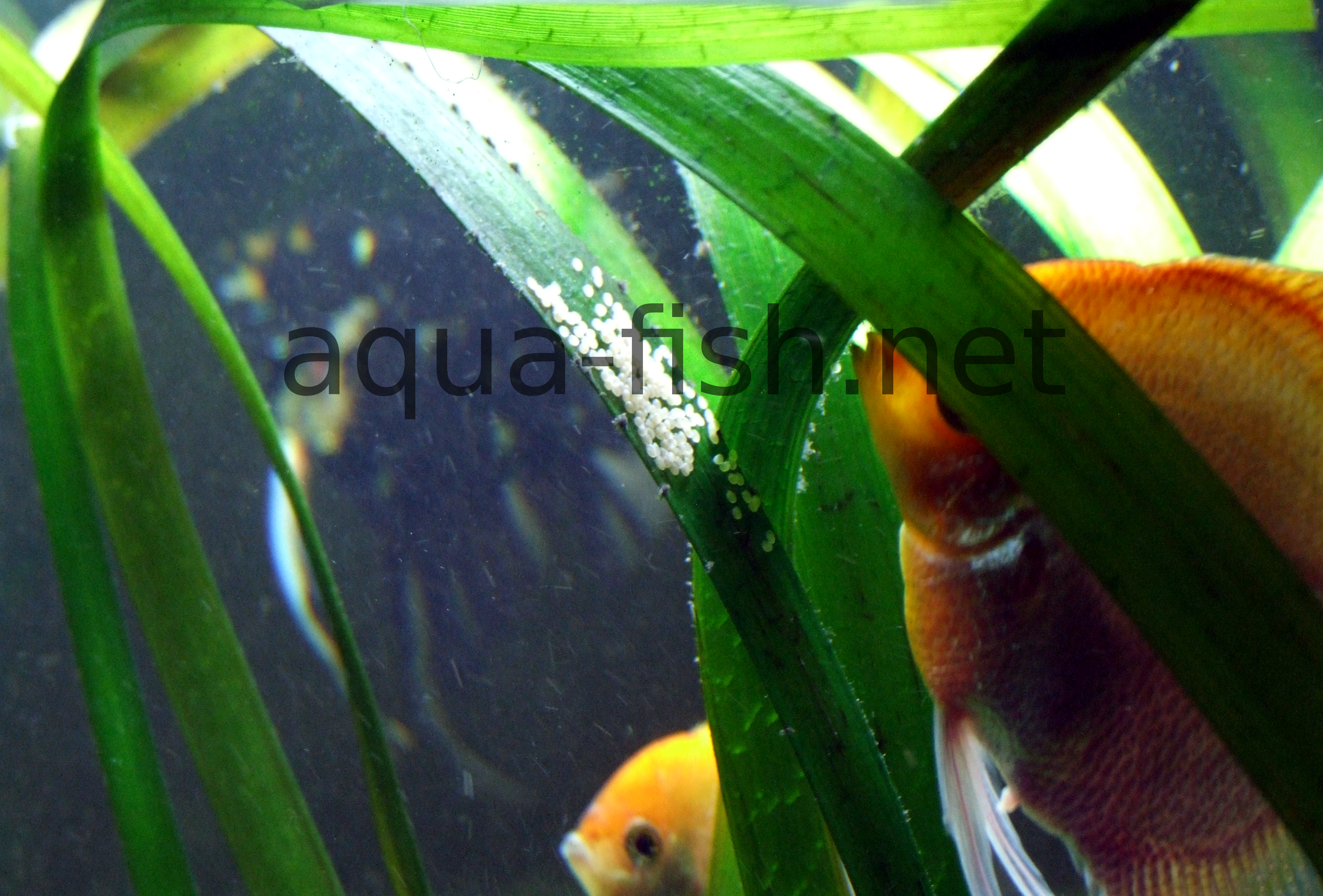
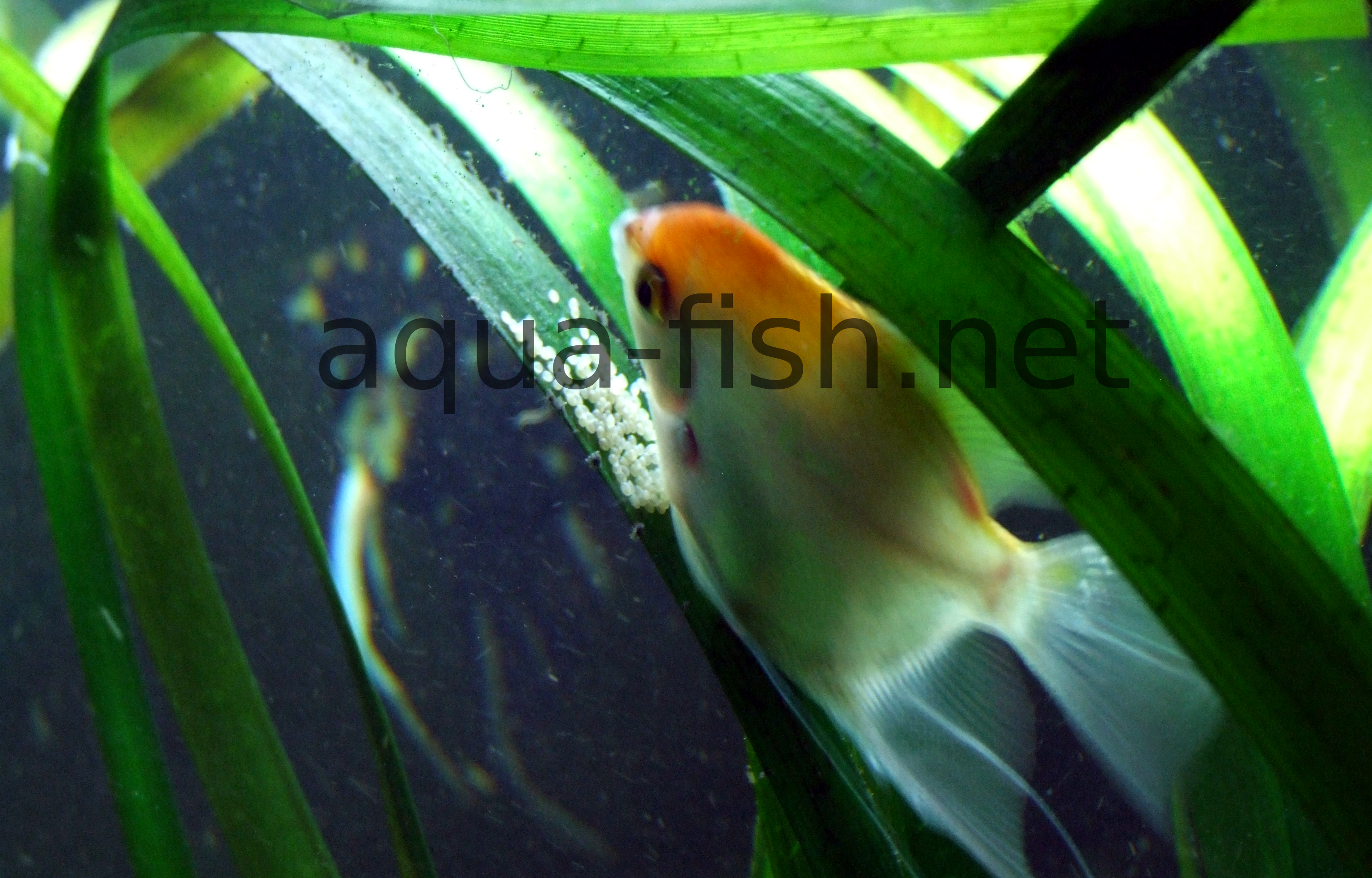
Angelfish are about to spawn once the genital papillae appears, these organs are used for depositing and fertilizing eggs. A place where eggs are to be laid is cleaned 2-3 days prior to reproduction. Once the pair starts the process of reproduction, the female will lay start laying eggs on a plant (it can be a rock or even filter too) and the male will fertilize them. All unfertilized eggs turn white, parents usually remove them. It’s possible that parents will eat eggs in case the breeding pair is young, or if they’re breeding for the first time. It is actually normal, the pair will stop doing this once they become skilled. If this behavior remains, it’s necessary to ensure that fish aren’t stressed.
Juveniles should hatch in 3-5 days. It isn’t necessary to feed them as they’re going to consume egg sac during first few days (up to 5), then it’s time to feed them Artemia salina, Daphnia or microworms. Feed newborns 4 times a day until they’re 3-4 weeks old. Once your Angels become 3 cm (1.18 inch) long, start feeding them Guppy fry in case you’re raising your own feeder fish. Buying feeder fish from aquatic stores is always risky as these may pass parasites to your fish. Bear in mind that diet of newborns must be varied!
Diseases
The most common diseases that freshwater Angels suffer from are as follows:
- Exophthalmia or Pop-Eye. Symptoms that characterize this disease include bloody spots, body sores, black spots on the body, loss of fins, fish may even look like suffering from tumors. Causes of this disease include lack of maintenance, infections caused by internal parasites, bacterial infections. Pop-eye can be caused by worm cataracts – the disease is characterized by cloudy eyes.
- Ichthyophthirius or Ich - White spot disease. It is caused by parasites, however background of this disease is again lack of maintenance, high levels of ammonia, stress, poor acclimatization, even newly introduced “non-quarantined” fish may spread this disease.
- Hunger strike; Loss of appetite.
Feel free to visit the article about the most common diseases in freshwater topical aquarium fish as it describes them very well and it wouldn't make any sense to repeat the already written content on this page: aquarium fish diseases.
Body & Varieties
There are a several varieties of Angelfish as follows:
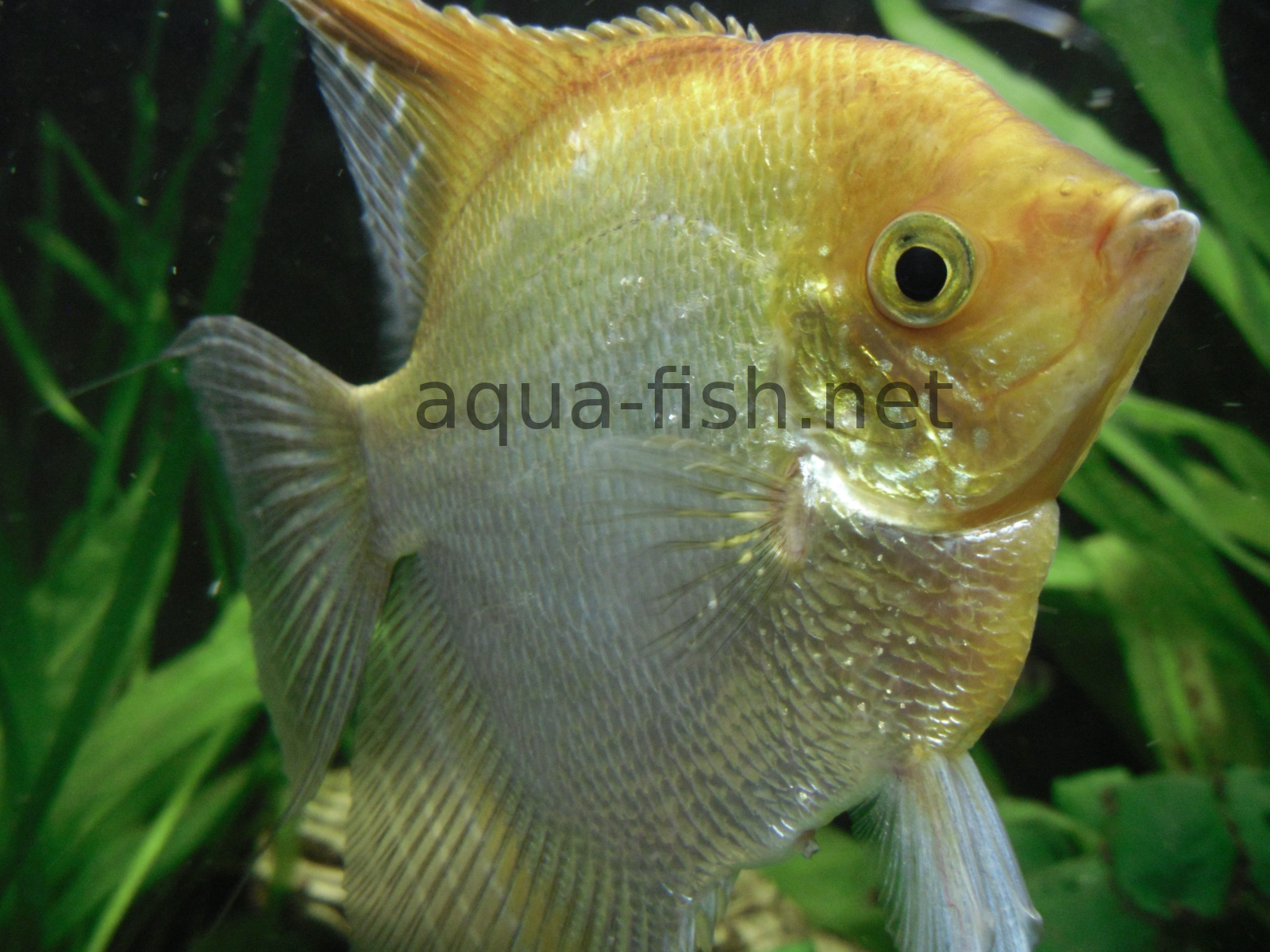
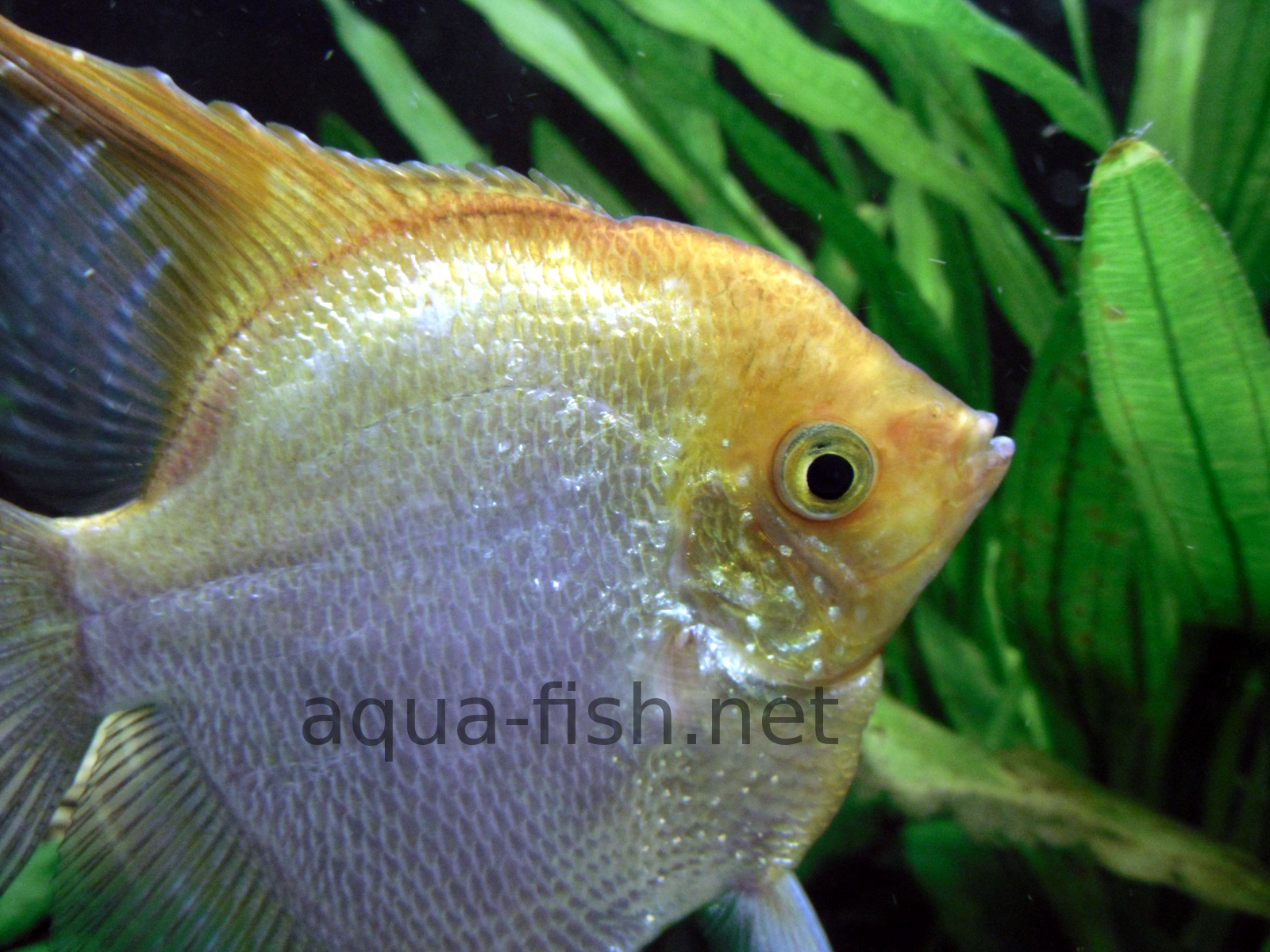
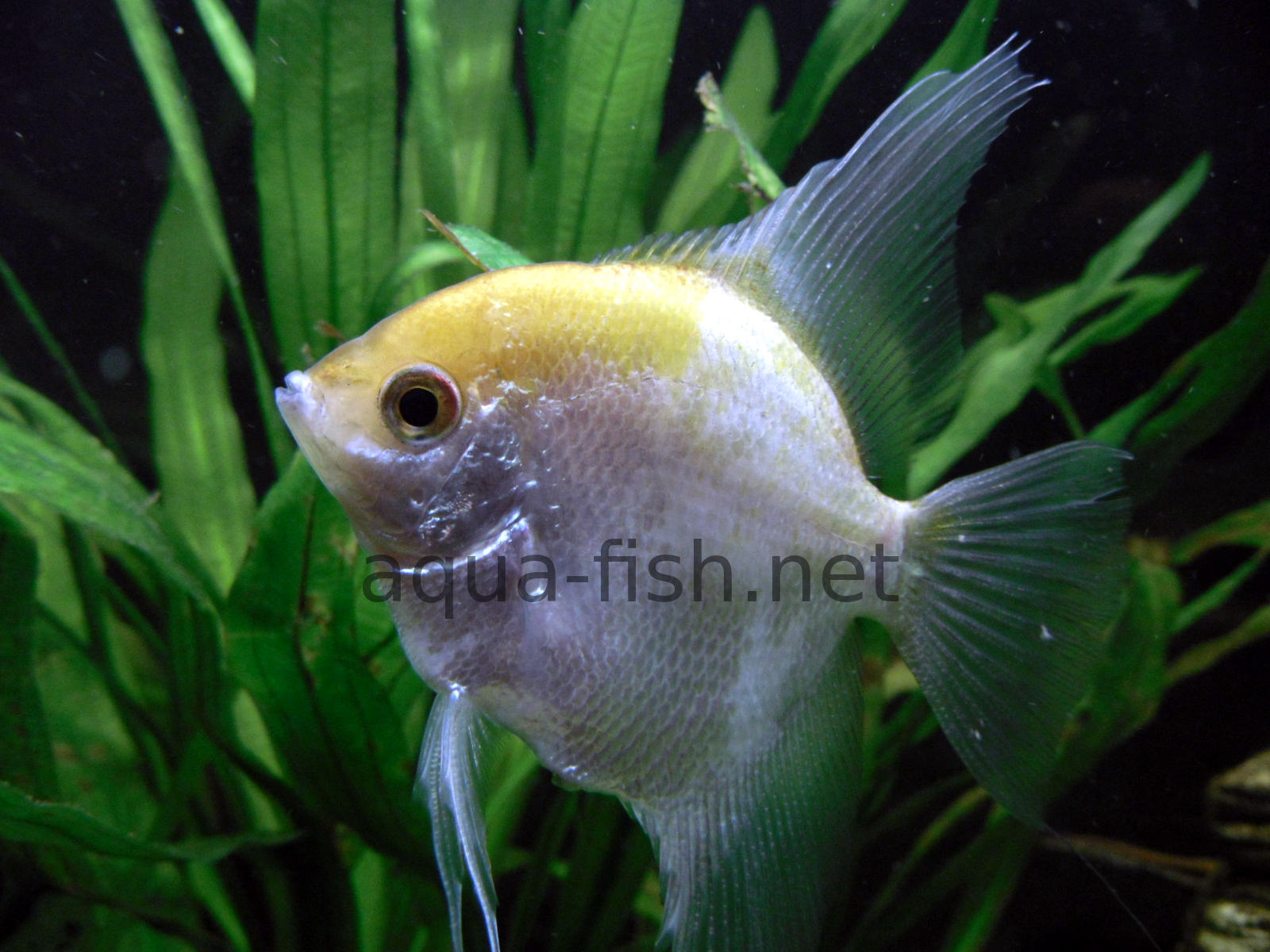
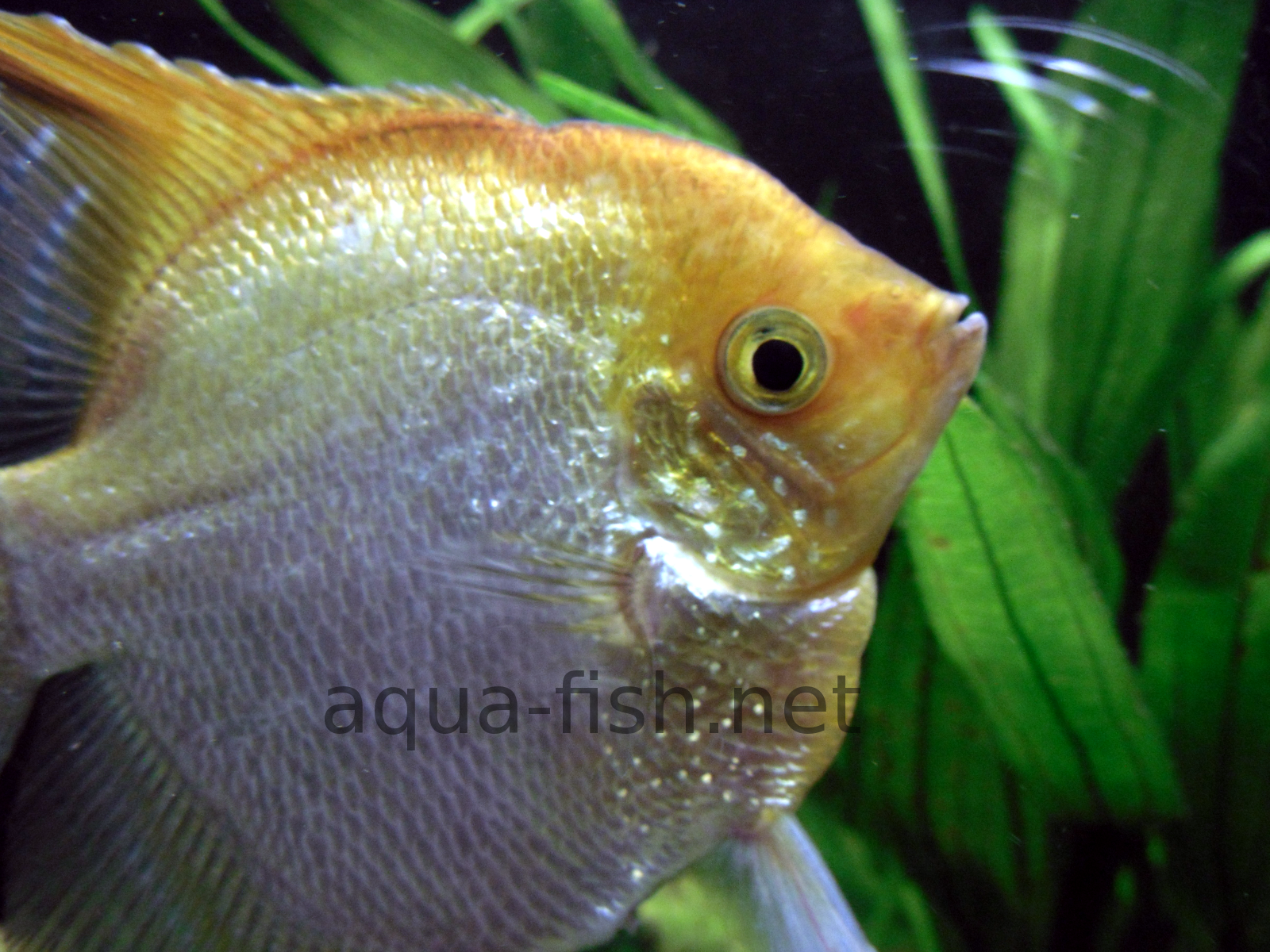
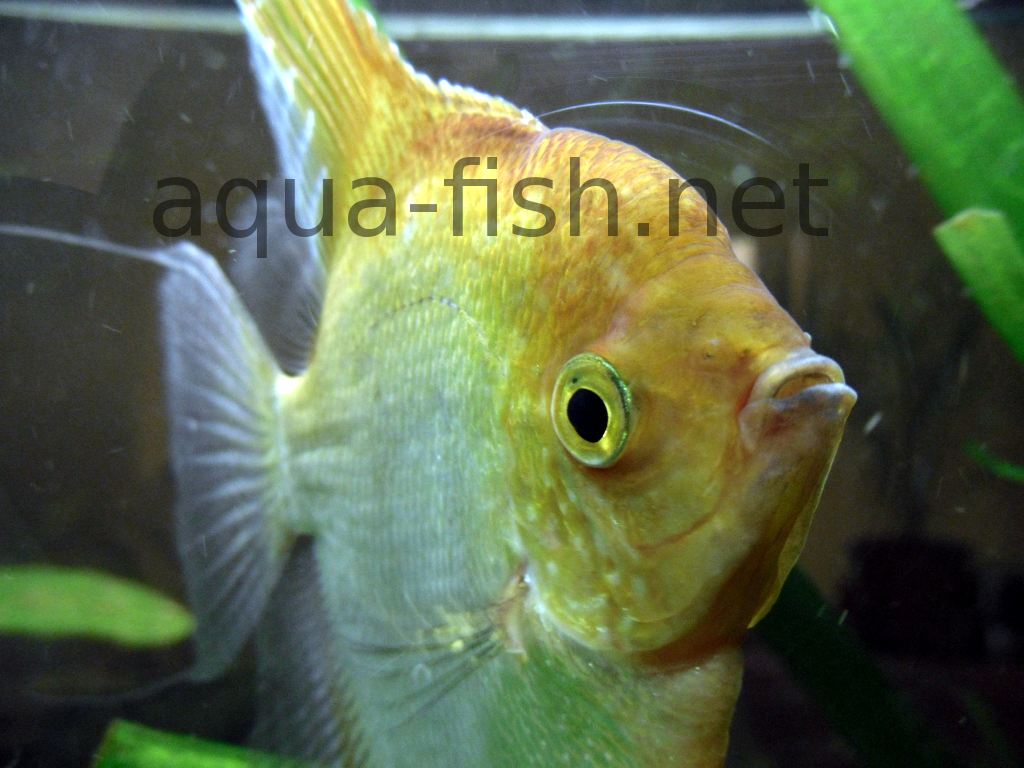
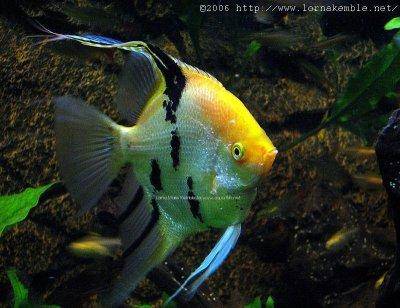
- Golden – Bodies of these fish are yellowish, it’s a light tone of yellow.
- Silver – These fish have silver bodies which are crossed with black vertical markings. This type of Angelfish can be dark, light, or solid.
- Koi – This type is characterized by red-white body with black and gold markings. Young Koi Angels are known for having red markings under their eyes.
- Smoky – A shade of silver on one half of the body, and a dark grey or ebony on the other half.
- Pearly gold – A dazzling shade of gold is the primary colour of this variety.
- Black – These fish look like solid ebony.
- Black lace – Black, but sporting wide light to dark stripes.
- Zebra – This variety has black body with white stripes.
- Marble – Marble-like swirls of silver and black appear on their bodies, there are black markings on fins of this variety, some have golden patterns on their heads.
- Blushing – Heads of this variety display golden markings, are a shade of white. Juvenile specimens may have red markings under their eyes.
- Blue blushing – These fish are grey in colour with outlines in black. Yound fish may have red markings under their eyes. This variety has ability to become dark or light according to their current feelings.
- Veiltail – Such Angels have elongated fins, they’re actually available in many colour variants.
Additional information about Angelfish
This part is a summary which is a “must know” for every owner of Angelfish:
- Lifespan of Angelfish depends on conditions in their tank, most Angels are capable of living even 8-9 years. However fish which aren’t looked after properly may live less than 4 years.
- Growth rate of Angels depends on diet, however most of them grow approximately 0.5-1 cm (0.2-0.4 inch) per month until they’re 6-8 months old, then their growth rate slows down. Adult Angelfish (Pterophyllum scalare) can reach 12-15 cm (4.7 – 5.9 inch) in length, males tend to be bigger than females. Full size is reached at 12 and 18 months of age.
- Since Angels don’t produce lots of excrements, they don’t pollute water and therefore their tank doesn’t need heavy maintenance. However if they’re kept in a community aquarium with fish which are known for producing a lot of waste (Guppies, Swordtails, Mollies), maintenance will have to be more regular. Testing water for pH, ammonia, nitrates, nitrites and carbonate hardness should be ideally performed once a week. The process of cleaning isn’t difficult, you actually have to use gravel vacuum cleaner only, add chlorine-free water into the tank once vacuuming is finished.
- Once again, Angelfish should be kept in large tanks, here’s a quick guide on recommended volumes:
Height of a tank must not be less than 40 cm (15.74 inch), ideal height is between 50 and 70 cm (19.68 – 27.55 inch). Plants should be present in an Angelfish tank, never keep more males than females in one tank, because males can be cruel when fighting for females! Ideal ratio is 1:2 (males:females).Liters /
US Gallons /
Imperial Gallons
Number of Angels
50 / 13 / 11 1 100 / 26 / 22 2 150 / 39 / 33 3-4 200 / 53 / 44 4-5 250 / 66 / 55 4-6 300 / 79 / 66 4-7 350 / 92 / 77 5-8 400 /105 / 88 6
Pictures of Angelfish
Thanks to Lorna Marie Kemble for the picture (a link to website has been removed on 6 March because the domain changed owner and content).
Thanks to Tamri Shavi too!

Additional questions and answers
On March 16th 2011 we updated this article again and moved questions from aqua-fish.net/answers here; Since this page contains plenty of comments, questions and answers already, it's possible that the below-listed questions may have been answered already here. If you cannot find answer on your questions on this page, feel free to use the form at the bottom of this page and ask us!
- What can I do now; my angelfish eggs have turned white?
Answer: If the eggs are white then there is nothing you can do. It means that the eggs have either not been fertilized or they have developed a fungal infection. Turning the filters right down will aid the male in fertilizing the eggs. Adding some methylene blue will help to prevent any fungal infection.
- Why is my angelfish fading and “holes” appearing on its skin surface?
Answer: The fading of the coloration, plus the “holes” sound like a fungal infection. Remove the fish as soon as possible to a quarantine tank as fungal infections can spread to the other fish. Treat with a commercial fungicide to clear up the problem.
- What pH do Angle fish (Angelfish) like?
Answer: Between 6 and 7. According to this page: link, they can be kept in waters with pH of 5.3 - 7.6.
- Where can I buy saltwater angelfish online?
Answer: On 10/05/08 we found saltwater angels for sale at www.liveaquaria.com for $26 to $580 USD depending on species. They can also be found at www.marineaquatics.net, you can contact them for availability and pricing information. Also www.justrarefish.com have saltwater angels for sale but you will need to contact them for availability and pricing information as well.
- Question: Where can I buy freshwater angelfish online?
Answer: On 10/05/08 we were able to find freshwater angels for sale at www.aquariumfish.net they ranged in price from $6 to $8 USD depending on species. At www.freshwaterangelfish.com they ranged from $8 to $26 USD depending on species and size. And at www.liveaquaria.com they can be purchased for $5-$30 USD depending on species.
- How big are angel fish when they are ready to breed?
Answer: Angel fish are normally ready to breed when they are 10-12 months old, the size of the fish will vary slightly but normally they will be about 3 inches (7.62 cm) in diameter.
Selling Angelfish
If you’ve successfully bred Angels, then you know that one batch of babies can range from 10 to 100, however most successful fish are able to produce even 1000 or 1500 eggs (but it’s rare to be honest) . Naturally it isn’t possible to keep all fish, thus consider selling or donating them later. Ideal size of sold specimens is 2-3 cm (approximately 0.8 – 1.2 inch), speaking generally the mortality rate doesn’t exceed 5% once they’re that big. Mortality can be reduced by using Artemia salina as primary food of hatchlings. Bear in mind that buyers should be told that their new fish aren’t going to stay that small forever!
Adult specimens can be sold for $30-$40 (US Dollars), juvenile specimens are usually worth $0.50-$1.00 (US Dollars) depending on geographic location and availability in pet stores. Show the breeding pair to the potential buyer, customers often want to see how their new fish will look in the adulthood.
Picture

Other useful webpages devoted to Angelfish
This page was created in order to give you a good insight on raising and breeding Angelfish, however the below-shown comments are worth reading too. There are some interesting and useful websites too, you're welcome to visit them! The Angelfish Forum @ angelfish.net, Angelfish Breeding @ angelfish.info, Angelfish @ fins.actwin.com, Angelfish - Common @ animal-world.com, Angelfish - Pterophyllum scalare @ fishlore.com. If any of these links doesn't work, let us know, please.
 Freshwater Angelfish - A guide and forums on care
 Breeding Freshwater Angelfish
 How to breed freshwater Angelfish in home fish tanks
 How to care for Clown loaches
 A guide and discussion on raising Electric Yellow Labs in fish tanks
 A guide on raising Galaxy rasboras in fish tanks